Cities are increasingly relying on urban experiments to make mobility transformations visible and tangible. Researchers from the MCube research project ReMIX are examining two examples from Munich in their study: the „TEMPUS“ test field for autonomous driving and the Digital Twin Munich for visualizing new cycling infrastructure.
Both projects aim not only to technically test possible future scenarios but also to communicate them to the public – for example, through real-life encounters with autonomous vehicles or 3D visualizations of planned street spaces. The authors describe this as „techniques of futuring,“ which make specific mobility visions tangible and plausible.
The study identifies three central mechanisms: making future visions visible („picturing“), preparing cities organizationally and infrastructurally („preparing“), and persuading the public and politicians („persuading“).
According to the analysis, digital twins and living labs, in particular, have a strong performative effect because they can convey complex changes emotionally and vividly. At the same time, the study emphasizes the need for critical reflection: urban experiments are never neutral, but require certain resources and often favor specific technological visions of the future over alternative ideas for sustainable mobility. Therefore, early and genuine public participation is necessary so that urban transformation is not only technically innovative but also democratically designed.
Here Goes to the article.

Develop the next mobility innovations for metropolitan regions. Together. Possible. To make it happen.
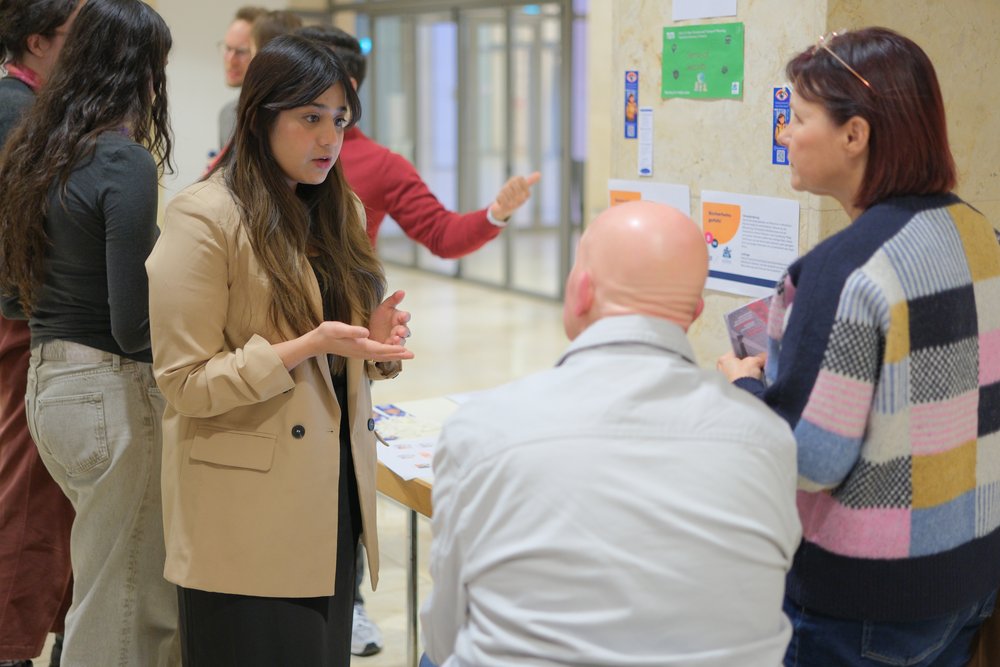
In 2025, representatives from various municipalities regularly met as part of a Community of Practice to exchange ideas on meaningful practices with urban data for sustainable mobility.
How can questions of equitable mobility be jointly researched and shaped? The seminar „Planning for Mobility Justice“ at the TU Munich highlights different perspectives on mobility (in)justice.
How can mobility innovations be designed responsibly — and what political frameworks are needed for this?
At re:publica 2026 in Berlin, MCube was represented at Europe's largest digital and society conference – with all 21 cluster and campus initiatives of the BMFTR.
5,000 guests, many insights: TUM's Sustainability Day made sustainable innovation tangible.
MCube Consulting is introducing SmartEvent, a digital tool that makes event registration in Munich easier and more efficient through the use of geodata.
The new study shows: Every euro invested in public transport in the MVV generates almost four times the economic value added.
Electric, autonomous, networked: The logistics industry is facing a major transformation. The MCube Speaker Series at the Deutsches Museum discussed how this future can become reality.
The lessons learned from the first MCube funding phase show which factors really drive projects forward - and where typical barriers arise.
No results available
What is MOSAIQ?
Imagine something: There is more space for people. The streets have more trees and plants. Everyone can get around better. That's how your Schwabing-West district could be in the future. How would you like your district to be? We want to talk to you about it!
The project is called MOSAIQ. MOSAIQ is a research∙project. MOSAIQ means: Mobility and urban climate in the future city∙part. The Technical University of Munich is leading the project.
What is MOSAIQ about?
MOSAIQ wants to make the streets in the city∙part more beautiful. People should feel comfortable there. There should be more space. For meetings and plants, for example. You can help decide what is tried out in the Stadt∙teil. The ideas come from you. Some ideas will be tried out on the streets for a certain period of time.
The aim of MOSAIQ is to make urban districts good places to live.
At the same time, the climate in the city should improve. And people should be able to move around the city easily.
What is happening in the district?