Olympics in Munich: An opportunity for the economy, the environment and society
Munich is currently considering a bid for the Olympic Games. This requires a sound basis for decision-making: what effects would the Games have on the economy, environment and society?
MCube Consulting was commissioned in July 25 to examine these issues in a short study. The study was developed in close cooperation with experts from the Technical University of Munich, the sports department, planning department and mobility department of the LHM and the traffic modeling department of Stadtwerke München.
How the study was conducted
The experts used various scientific methods for the study:
- Assumptions and data were collected.
- Various scenarios were calculated to examine the impact of different factors.
- Guided interviews were conducted with experts.
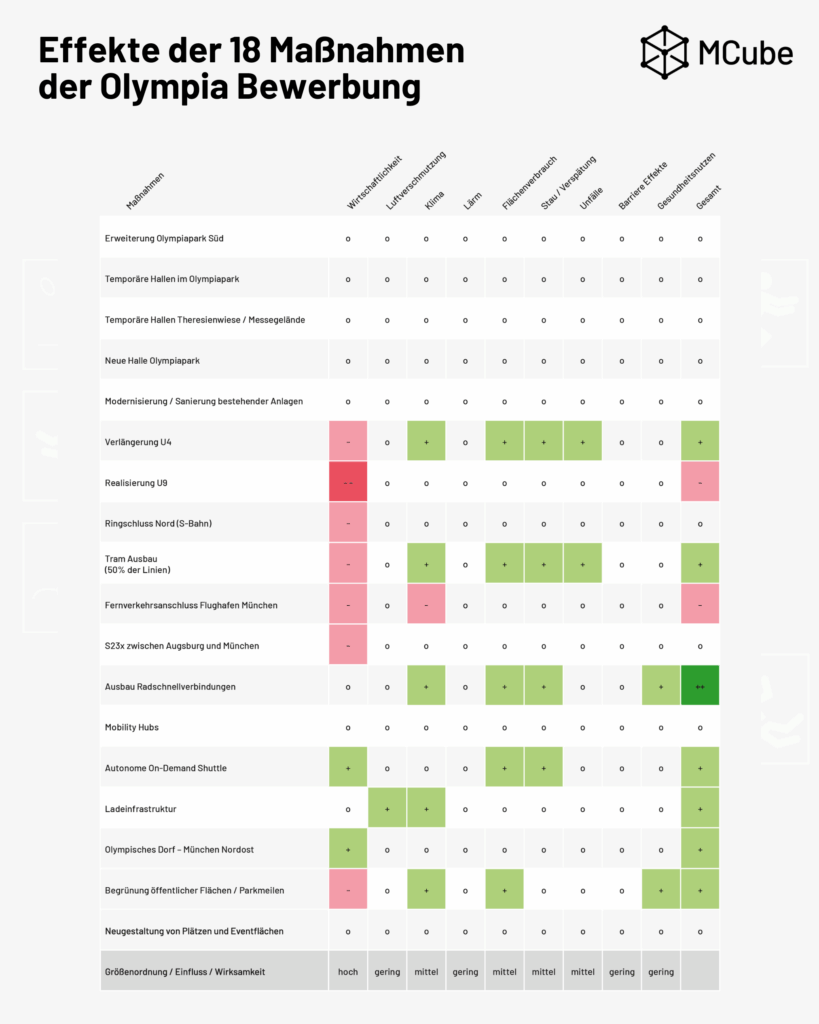
- This was based on experience from previous Olympic Games, other major events and the evaluation of 18 planned measures in Munich.
The aim was to assess the overall economic benefits and sustainability of hosting the event. Opportunities - such as upgrading the city, better mobility and a positive image - were considered alongside risks, such as high costs, environmental impact and the limited ability to control large infrastructure projects. Rent increases and gentrification only played a subordinate role.
Why the games bring added value
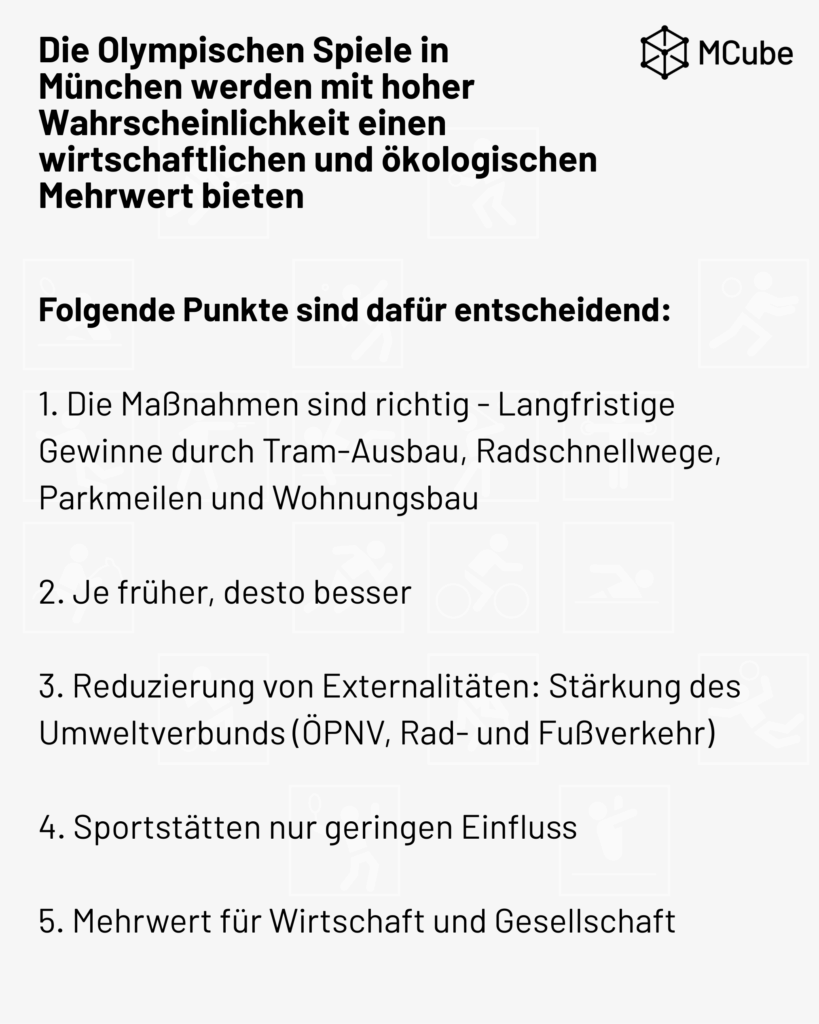
The study shows that the Olympics can generate long-term positive effects for Munich if the risks are actively managed:
- The right measures, regardless of the Olympics: streetcar expansion, fast cycle routes, park miles and new housing construction already bring long-term benefits without the Olympics - the Games act as an additional impetus.
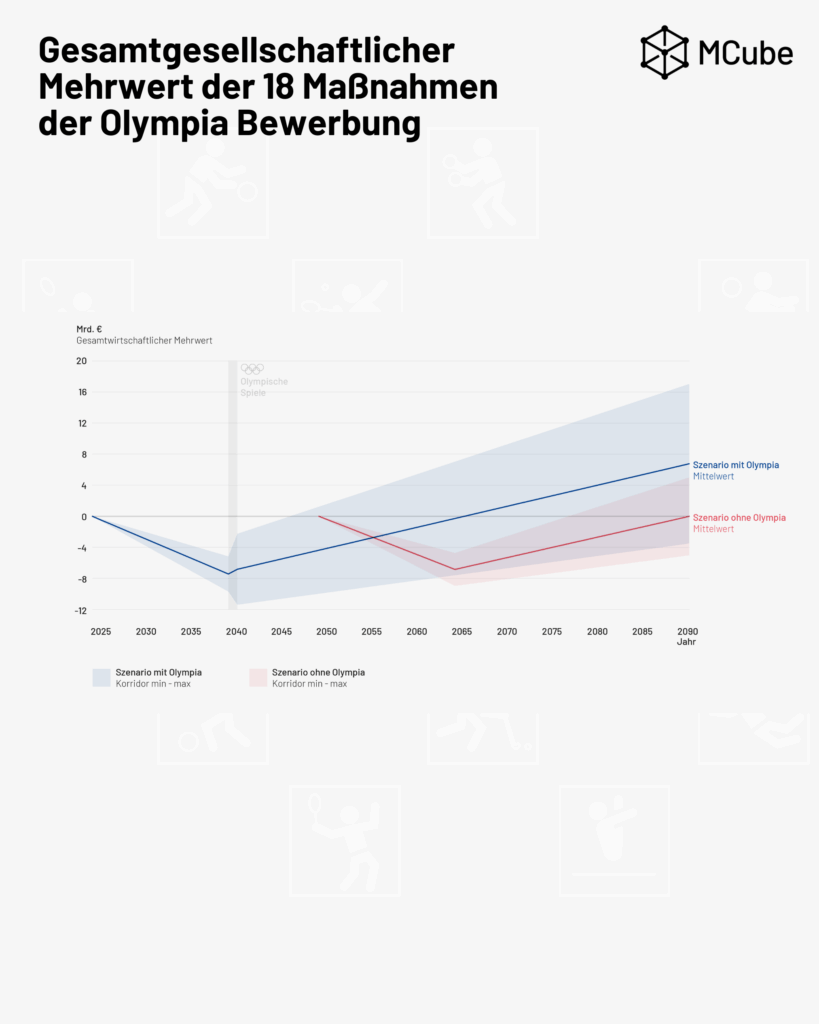
- Early implementation pays off: The earlier the measures are implemented, the longer the city and its citizens benefit.
- Environment and health benefit: More cycling and walking as well as improved public transport reduce CO₂, land consumption and promote health.
- Sports facilities with little impact: New sports facilities incur costs, but the long-term benefits of the infrastructure measures clearly outweigh them.
- Economic and social benefits: The Olympics strengthen Munich's image, create economic impetus and promote encounters, inclusion and inspiration ("melting pot" effects).
Scenario analyses show a potential of up to low double-digit billions, while in the negative case a loss in the single-digit billion range is possible.
Recommendations for the state capital
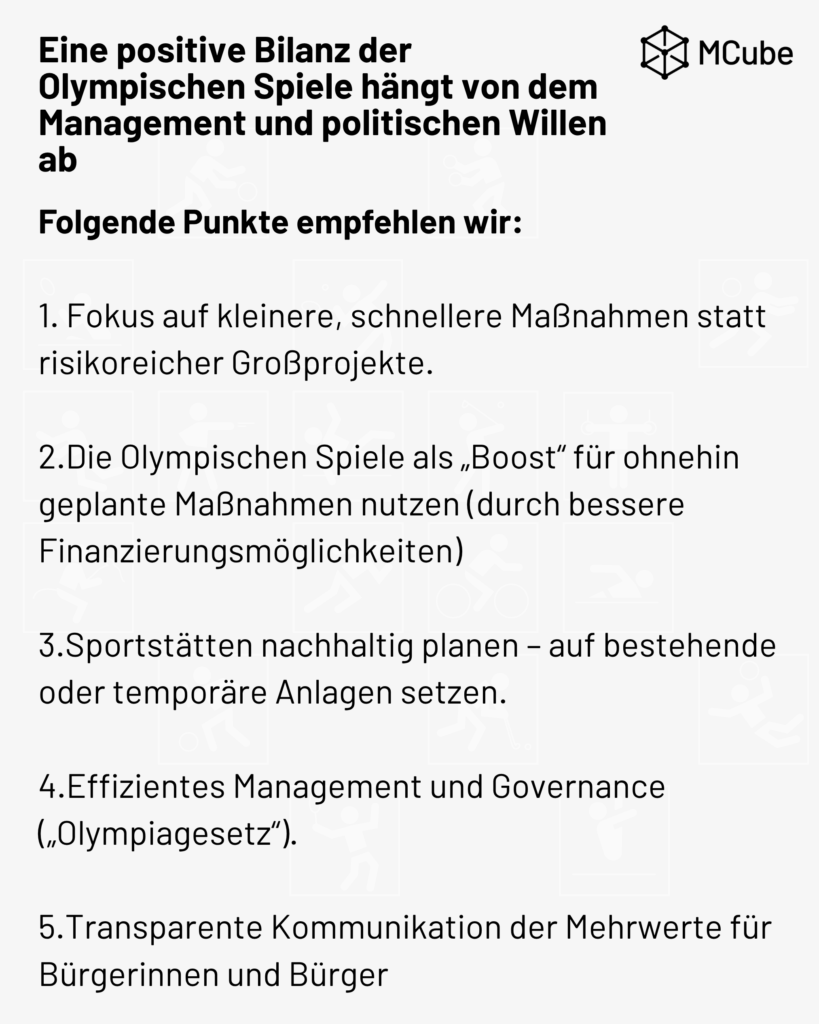
The experts recommend that Munich gets the maximum benefit from the Olympics:
- Give preference to small, quickly implementable measures: streetcars, cycle paths and park miles bring secure added value - avoid risky large-scale projects such as subway extensions.
- Using the Olympics as a boost: The Games can serve as a funding boost for measures that are already planned.
- Planning sustainable sports facilities: Use existing facilities or implement temporary, cost-effective solutions.
- Ensure efficient management and governance: Political processes and resources must be clearly regulated - possibly through a separate "Olympic law".
- Transparent communication: Citizens should be comprehensively informed about economic, ecological and social added value.
Scientifically sound
Team of authors - MCube Consulting: Dr.-Ing. Daniel Schröder and Felix Waldner
Team of experts - TU Munich: Prof. Hanna Hottenrott, Prof. Gebhard Wulfhorst, Prof. Allister Loder, Dr. Nadia Alaily-Mattar and Oliver May-Beckmann (TUM/MCube)
Conclusion
With targeted, sustainably planned measures, the Olympic Games can strengthen Munich far beyond sport - as a city with sustainable mobility, strong economic impetus and a vibrant society.
👉 Click here to download the Study and the Infosheets.