What is this use case about?
This is exactly what we want to achieve with our Use Case 1: We are committed to establishing mobility budgets as an attractive benefit for employees in companies. This way, employers can not only support their employees on their way to sustainable mobility but also strengthen their attractiveness as modern employers.
We are particularly interested in: How does employee mobility behavior change when companies offer them attractive mobility options? Can we achieve that employees try out new modes of transport and can comfortably choose the right mode of transport depending on the situation?
Let's rethink mobility together and make it more sustainable!
Sustainable travel
at work
The project aims to attract more people to sustainable mobility options and thereby make a tangible contribution to the transportation transition in Munich. Specifically, we want to promote the use of the so-called "Umweltverbund," which encompasses not only classic public transportation like buses and trains but also flexible shared mobility services, bicycles, e-scooters, and other forms of mobility.
In addition, we want to find out how such an offer affects mobility behavior. We are particularly interested in whether and to what extent trips can be shifted from private cars to more sustainable forms of transport. The findings are intended to serve as a basis for future mobility solutions that can also be implemented beyond Munich.
Due to current funding regulations, it is not yet possible to implement such programs on a permanent basis within the Fraunhofer-Gesellschaft. Participation in the pilot phase, however, is not affected by this. If the results show that mobility budgets promote more sustainable mobility behavior, they can provide an important foundation for further pursuing this topic in the future and developing appropriate framework conditions.
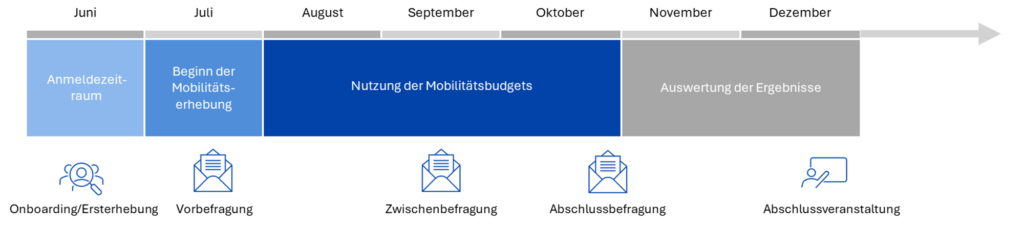
The test phase will be conducted in the summer of 2026 together with selected employees of the Fraunhofer Society. Pre-tracking will begin on July 1, 2026. The test phase will last a total of four months and will end on October 31, 2026. The test phase consists of two parts: Pre-tracking and the Budget Phase. The test phase begins with one month of pre-tracking.
To do this, install the TUM Mobility app on your smartphone. This app automatically and anonymously records your journeys.
After that, the budget phase begins. Here we provide you with a mobility budget.
You can test this for three months according to your individual needs. Your journeys will also be recorded with the TUM Mobility App during this time. The trial period therefore lasts a total of four months.
Use-Case-Specific Q&A
Your Questions &
our answers
General
A fixed sum of money that can be flexibly used for various modes of transportation as desired. During the MobiPionier test phase, management and use are conveniently handled through the uRyde mobility budget app.
With a mobility budget, different transportation services can be used flexibly and according to needs. Whether public transport, bicycle, or car sharing – different options can be conveniently combined and selected according to the situation.
This financial support from the employer promotes employee satisfaction, as it allows for more freedom and self-determination in their daily mobility, both for commuting and during leisure time. Administration is simple and clear via an app, ensuring transparency about the monthly budget already used at all times. During the trial phase, the mobility budget will be provided free of charge to participants through the research project.
Multimodal mobility means using different modes of transport for a route or journey depending on the need. For example, you might take the subway one day and a bicycle or a car-sharing car another day.
Even within a single travel chain, transportation methods can be combined sensibly: for example, part of the route can be covered by subway, and for the rest of the way, you switch to a bike-sharing bicycle.
Participation and Process of the Test Phase
Note: The mobility budget can only be used for mobility services within Germany.
We want to strengthen the use of public transport and sharing services. Therefore, the following mobility services can be paid for with the mobility budget:
Not with the Mobility budget The following mobility services can be paid for:
The Mobility budget The three-month trial period will include €100.00 per person per month. Therefore, a maximum of €300.00 per person will be available during the trial period. If the budget is not used up in a given month, it can be carried over to the next month. If the total budget is not used up by the end of the trial period, it will expire.
It is digitally managed Mobility budget about the uRyde mobility budget app.
The booking is made via a digital debit card, which is loaded with the budget monthly. The card can then be stored as a payment method in common apps (e.g., MVGO, Miles, Bolt).
Information materials and instructions for using the uRyde mobility budget app can be found at https://info-center.uryde.de/faq/mobilitaetsbudget.
Yes, participation in the test phase is free for participants. The budget costs will be fully covered.
Note: The Technical University of Munich points out that the mobility allowance granted within the scope of this study (€100 per month for three months, total €300) must be taxed independently.
You were contacted to participate in the pilot phase because you belong to the target group of MobiPionier. The target group includes all employees of Fraunhofer ZV and EMFT. Participants are selected exclusively for research purposes. Your participation helps us better understand how Mobility budgets can be used in everyday pendulum operations and how they can be further improved.
All individuals who can participate in the test phase are those who
Due to limited project funding, there is unfortunately no guarantee of being selected for the test phase after applying as a test participant.
The selection of test subjects will be carried out using scientific methods by TUM. If you do not register in the apps by June 28, 2026, after your confirmation, you will be excluded from the study. Therefore, other test subjects will be able to take your place.
Yes, participation in the study is voluntary. You decide for yourself whether you want to participate. You can decide at any time not to participate further without giving reasons. You will then no longer receive a mobility budget.
Please tell us about mobipionier.sv@ed.tum.de you, if you no longer wish to participate in the test phase.
If data has already been collected from you as part of the study, you can also indicate whether it may continue to be used for scientific evaluation or whether it should be deleted, as far as this is possible under data protection law.
You will need a functional smartphone with internet access and should be proficient in using it. For the testing phase, you will need to TUM Mobility App download to your smartphone and keep it installed for the entire duration of the trial period.
For the mobility budget, you also need the uRydeApp. You book and pay for transportation services with the digital debit card.
Ideally, you should be in Munich for most of the test phase, as the study focuses on everyday commuting. However, since the test phase falls during the summer holidays and vacation period, participation is also possible if you are not in Munich for periods of time. The only important thing is that you do not spend more than four consecutive weeks outside of Munich during the entire test period.
If you participate in the study, you must download and register for the TUM Mobility App. In addition, you must record and confirm your daily journeys with it until the end of the test phase. Furthermore, you must install the uRyde mobility budget app to be able to use the mobility budget provided for you there. To do this, the provider will provide you with a digital debit card. In addition, we will ask you for brief feedback several times during the test phase. Your feedback will help us to better understand the study and improve future research projects. In total, you will receive three surveys, each taking only a few minutes.
You will be informed by email no later than 3 days before the start of the test phase whether you have been selected to participate.
If the price of an offer exceeds the currently available budget, the payment will be automatically declined. It is not currently possible to split the amount into a proportional budget portion and a private payment portion. However, unused budget does not expire immediately but can be carried over to the following month.
The mobility budget is provided as a virtual debit card (Mastercard) and can be used wherever corresponding payments are accepted. It can also be deposited into Apple Pay or Google Pay. Other payment methods such as cash, debit card, or direct debit are excluded. Usage is limited to the means of transport defined in the project and is exclusively intended for use within Germany.
As a rule, booking and billing are handled through the respective provider apps, making their use necessary. At the same time, integrated platforms such as MVGO exist, which allow various mobility offers to be used in a bundled manner. The debit card can also be stored and used there.
The Deutschlandticket can be booked via uRyde, with a 5 percent discount. It is not a traditional subscription, as the decision to purchase is made anew each month. There is no automatic renewal or notice periods, which ensures flexible usage.



Are you interested in working with MCube?
Feel free to get in touch with us then.
What is MOSAIQ?
Imagine something: There is more space for people. The streets have more trees and plants. Everyone can get around better. That's how your Schwabing-West district could be in the future. How would you like your district to be? We want to talk to you about it!
The project is called MOSAIQ. MOSAIQ is a research∙project. MOSAIQ means: Mobility and urban climate in the future city∙part. The Technical University of Munich is leading the project.
What is MOSAIQ about?
MOSAIQ wants to make the streets in the city∙part more beautiful. People should feel comfortable there. There should be more space. For meetings and plants, for example. You can help decide what is tried out in the Stadt∙teil. The ideas come from you. Some ideas will be tried out on the streets for a certain period of time.
The aim of MOSAIQ is to make urban districts good places to live.
At the same time, the climate in the city should improve. And people should be able to move around the city easily.
What is happening in the district?