What is this use case about?
Imagine your employer actively supporting you in commuting in an eco-friendly and flexible way – tailored to your needs!
This way, employers can not only support their employees on the path to sustainable mobility but also strengthen their attractiveness as a modern employer.
We are particularly interested in: How does employees' mobility behavior change when companies offer them attractive incentives?
Can we achieve that people try new modes of transport and can comfortably choose the most suitable mode of transport for each situation?
With this project, we want to learn how mobility budgets work in practice and how such solutions can be implemented in other cities and regions in the future.
Let's rethink mobility together and make it more sustainable!
Sustainable travel
at work
The project aims to attract more people to sustainable mobility options, thereby making a significant contribution to the transport transition in Munich. Specifically, we want to promote the use of the so-called "Umweltverbund" (environmental network).
These include classic public transport such as buses and trains, as well as flexible shared mobility services, bicycles, e-scooters, and other forms of mobility. In addition, we want to find out how such an offer affects mobility behavior.
We are particularly interested in whether and to what extent travel can be shifted from private cars to more sustainable modes of transport. The insights gained are intended to serve as a basis for future mobility solutions that can also be implemented beyond Munich.
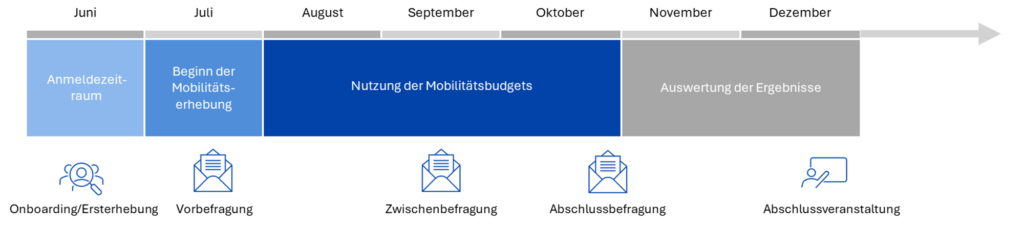
The test phase will be conducted in summer 2026 together with selected employees from SWM. Pre-tracking will start on July 1, 2026. The test phase will last a total of four months, ending on October 31, 2026. The test phase will consist of two parts: Pre-tracking and the budget phase. The test phase begins with one month of pre-tracking.
To do this, install the TUM Mobility app on your smartphone. This app automatically and anonymously records your journeys.
After that, the budget phase begins. Here we provide you with a mobility budget.
You can test this for three months according to your individual needs. Your journeys will also be recorded with the TUM Mobility App during this time. The trial period therefore lasts a total of four months.
Use-Case-Specific Q&A
Your Questions &
our answers
For employees
A fixed amount of money that can be flexibly used for various modes of transportation as desired. Management and usage during the MobiPionier test phase are conveniently done via the MVG Mobility Budget App.
With a mobility budget, various transportation services can be booked flexibly and as needed. Mobility budgets make it easier to use means of transport such as public transport, bicycles, or carsharing.
Mobility budgets can increase participant satisfaction because they give them more self-determination over their mobility. Mobility budgets can be managed easily and transparently via app. You always have an overview of the budget already used per month. During the trial phase, mobility budgets will be made available to test users free of charge.
Multimodal mobility means combining different modes of transport for a journey or trip, depending on what is most practical at the time. For example, one day you might use the subway, and another day you might use a bicycle or a carsharing vehicle. The modes of transport can also be combined within a single journey. For instance, you might travel part of the way by subway and then switch to a bikesharing bike for the remainder of the trip.
Participation and Process of the Test Phase
With the Mobility budget Can the following mobility services be paid for:
Not with the Mobility budget The following mobility services can be paid for:
The Mobility budget will include €100.00 per person per month during the three-month trial period. A maximum oftphase also €300.00 per person. If the budget is not used up within a month, can be carried over to the next month. If the total budget is not used up by the end of the trial period, it will expire.
For the test users, the mobility budget will be free of charge during the test period. However, for technical reasons, it is necessary that the test users, in You will be reimbursed for the disbursed funds, corresponding to the agreed-upon test amount minus any applicable taxes, with the payroll statement of the following month.
You will receive the mobility budget through our project partner, Stadtwerke München GmbH. The principle of advance payment applies. This means that you will book mobility services as usual directly through the apps of the respective mobility providers.check and pay. You will be reimbursed for the money paid out in the amount of the agreed test amount minus any applicable taxes with the payroll statement of the following month.
The mobility budget is managed digitally via the MVG Mobility Budget App. You can easily upload receipts for your trips and mobility services through the MVG Mobility Budget App's receipt scanner and submit them. You book and pay for transport services as usual, directly through the respective mobility provider's apps. You will receive detailed information materials and instructions on how to use theMVG Mobility Budget App from us.
You were contacted to participate in the testing phase because you belong to the target group of MobiPionier. The target group includes all employees of Stadtwerke München GmbH. Participants are selected solely for research purposes. Your participation helps us to better understand howMobility budgetsthat can be used in everyday commuting and how they can be further improved.
All individuals who can participate in the test phase are those who
Further information on the terms and conditions can be found here.
Due to limited project funding, there is unfortunately no guarantee of being selected for the test phase after applying as a test participant.
The selection of test subjects will be carried out using scientific methods by TUM.
Yes, participation in the study is voluntary. You decide for yourself whether you want to participate. You can decide at any time not to participate further without giving reasons. You will then no longer receive a mobility budget.
Please tell us about mobipionier.sv@ed.tum.de you, if you no longer wish to participate in the test phase.
If data has already been collected from you as part of the study, you can also indicate whether it may continue to be used for scientific evaluation or whether it should be deleted, as far as this is possible under data protection law.
You should own a functional smartphone with internet access and be proficient in its use. For the trial phase, you must TUM Mobility App download to your smartphone and keep it installed for the entire duration of the trial period.
For the mobility budget, you also need the MVG Mobility Budget-App from SWM/MVG. You book and pay for transportation services as usual, directly through the respective mobility providers' apps.
The test phase consists of two parts: pre-tracking and the budget phase. The test phase begins with one month of pre-tracking. For this, install the TUM Mobility App on your smartphone. This app automatically and anonymously records your journeys.
After that, the budget phase begins. Here we present you with a Mobility budget available. You can test this for three months according to your individual needs. Your journeys will also be recorded with the TUM Mobility App during this time. The test phase therefore lasts a total of four months.
The test phase will take place within the city of Munich. You are testing this Mobility budget however, entirely to their individual needs in their daily lives. You do not need to appear in person at the Technical University of Munich to participate in the test phase. However, we will offer a voluntary information event at the beginning of the test phase.
It would be good if you are in Munich for the majority of the test phase, as the research focus is on your everyday commuting mobility. However, since the test phase falls during the summer holidays and vacation season, you can also participate if you are not in Munich for some time. Nevertheless, an absence from Munich for longer than two weeks during the test phase should be avoided as much as possible.
You will be informed by email no later than 3 days before the start of the test phase whether you have been selected to participate.
The protection of participants' personal data is our highest priority. All collected data will be anonymized and used exclusively for research purposes. Data protection regulations will be strictly adhered to. It is not possible to draw conclusions about individuals. Further information can be found in the FAQ Section.



Are you interested in working with MCube?
Feel free to get in touch with us then.
What is MOSAIQ?
Imagine something: There is more space for people. The streets have more trees and plants. Everyone can get around better. That's how your Schwabing-West district could be in the future. How would you like your district to be? We want to talk to you about it!
The project is called MOSAIQ. MOSAIQ is a research∙project. MOSAIQ means: Mobility and urban climate in the future city∙part. The Technical University of Munich is leading the project.
What is MOSAIQ about?
MOSAIQ wants to make the streets in the city∙part more beautiful. People should feel comfortable there. There should be more space. For meetings and plants, for example. You can help decide what is tried out in the Stadt∙teil. The ideas come from you. Some ideas will be tried out on the streets for a certain period of time.
The aim of MOSAIQ is to make urban districts good places to live.
At the same time, the climate in the city should improve. And people should be able to move around the city easily.
What is happening in the district?