Mobility budgets and mobility bundles in the Munich metropolitan region as an alternative to regulation
What is MobiPionier?
Imagine: Mobile on the go – simply flexible and environmentally friendly. Without being tied to a single mode of transport and suiting every journey.
Aim of the project
We think mobility innovatively and holistically
In MobiPionier, we want to increase the use of eco-mobility - such as buses and trains, sharing services and bicycles - and ensure that different modes of transportation can be flexibly combined.
The central question is: How can sustainable mobility services be designed in such a way that they really fit into people's everyday lives?
Mobility bundles
Different means of transportation, for example bus, train and e-scooter, are combined into a package at a fixed price.
Mobility budgets
A flexible amount of money that can be used for different means of transportation as desired - simply via app!
From the idea to everyday life
An iterative process for developing and testing new mobility services
Understand
We analyze how existing apps and offers work and what people really need.
Design
Together with the City of Munich, companies and citizens, we develop the best budget and bundle solutions.
Testing
The services are being tested in real-world laboratories for everyday mobility and for traveling to and from major events.
Evaluate
We measure how well Mobility budgets and Mobility bundles and what effects they have.
MCube is the „Munich Cluster for the Future of Mobility in Metropolitan Regions.“ As a transfer and application cluster, we develop scalable solutions for the mobility of the future together with over 80 partners from science, business, administration, and civil society. The cluster is led by the Technical University of Munich (TUM) and is funded by the Federal Ministry of Research, Technology and Space (BMFTR). The focus is on key mobility topics such as autonomous driving, electromobility, smart infrastructures, legal frameworks, and the livable redesign of public spaces.
What is the background of MobiPionier?
MobiPionier is part of “MCube” - the “Munich Cluster for the Future of Mobility in Metropolitan Regions.” It is one of nine projects in the second phase of the MCube research cluster. MobiPionier stands for „Mobility Budgets and Bundles in the Munich Metropolitan Region as an Alternative to Regulation.“ MobiPionier focuses on the idea that a person is not reliant on a single mode of transport but can flexibly use different modes of transport for various travel purposes.
What is a mobility bundle?
Various means of transport, such as buses, trains, and e-scooters, are combined into a package for a fixed price.
What is a mobility budget?
A fixed sum of money that can be flexibly used for various means of transport as desired. During the MobiPionier test phase, the mobility budget can be conveniently managed and used via an app, such as the MVG Mobility Budget App.
What is a use case?
A use case (often called „Anwendungsfall“ in German) describes a very specific real-life situation in which an idea, technology, or research result can actually be used and tested.
How do the use cases differ?
The project is testing mobility budgets and mobility bundles for various everyday situations. For example, people have different needs for commuting to work than for a weekend excursion. Therefore, we are examining two scenarios in the use cases:
Mobility for Commuters and Employers
Mobility in everyday life and leisure
What is a real-world lab?
A real-world laboratory (often called a Living Lab or Real-World Lab in English) is a research and experimentation space in the real world. In it, new ideas, technologies, or social solutions are tested with individuals from science, politics, business, and the general public under real conditions. We also call the MobiPionier real-world laboratory the „test phase“.
How do citizens benefit from the MobiPionier project?
You will gain access to new, flexible mobility options that will make your everyday life more convenient and sustainable. And by participating, you will help us develop tailor-made offers for the Munich metropolitan region.
How can you participate?
The project is open to anyone who is curious about new forms of mobility and wants to help shape the future. Commuters, students, families, or seniors. You can find out about news on this website.
Do you have to get rid of your car for this?
No! It is not about prohibitions, but about providing new alternatives. You decide for yourself when to switch to buses, trains, bicycles, or shared mobility services. MobiPionier offers more freedom and less dependence on your car, without any coercion.
How is the data protection and security of participants in the trial phase ensured?
The protection of participants' personal data is our highest priority. All collected data will be anonymized and used exclusively for research purposes. Data protection regulations will be strictly adhered to.
Project partners
MobiPionier relies on Collaboration
Experienced partners from science, administration, business and society work together in MobiPionier under the leadership of the Technical University of Munich.
Science
Professorship for Mobility Policy at the Technical University of Munich
The Chair of Mobility Policy at TUM researches political, regulatory and social aspects of urban mobility. We develop evidence-based recommendations for action for urban planning, transport policy and sustainable mobility strategies. The professorship combines scientific analysis with practical projects and supports decision-makers in administration, business and politics in the design of future-proof, digitally networked and sustainable transport systems.
Chair of Settlement Structure and Transport Planning at the Technical University of Munich
At the Chair of Settlement Structure and Transport Planning at TUM, we research how cities or other forms of settlement and transport can be designed in such a way that all people can travel sustainably and reach their destinations with the shortest possible distances. We develop methods to find gaps in this accessibility and work together with society and practitioners to develop solutions for sustainable, liveable and equitable urban development.
The Mobility Department (MOR) is the central point of contact for all strategic issues relating to mobility and transportation in Munich. Our goal is equal and safe coexistence on our roads and a better quality of life in Munich.
Deutsche Bahn Connect is a subsidiary of Deutsche Bahn and develops and operates digital and sustainable mobility solutions such as car and bike sharing, for example Flinkster and Call a Bike. It also handles DB's fleet management, develops mobility budgets and networked transportation solutions for companies, cities and private customers. The aim is efficient, networked and environmentally friendly urban mobility.
Stadtwerke München GmbH (SWM)
Stadtwerke München supplies the Bavarian capital and the region with energy, drinking water, telecommunications and public transport. We contribute to a networked and sustainable urban infrastructure via the subway, bus and streetcar. We rely on renewable energies and digital solutions to shape sustainable cities.
Münchner Verkehrs- und Tarifverung GmbH (MVV)
The Munich Transport and Tariff Association (MVV) coordinates local public transport in Munich and the surrounding area. We integrate S-Bahn, U-Bahn, streetcar, bus and regional trains under a common fare and transport planning system. With standardized tickets and timetables, the MVV supports efficient, reliable and user-friendly mobility.
Society
ADAC Foundation
The ADAC Foundation promotes safe and sustainable mobility and is committed to accident prevention. It supports educational and research projects on road safety, mobility of the future and first aid measures. With practical programs, the foundation contributes to improving safety and mobility skills in Germany.
Are you interested in working with MCube? Feel free to get in touch with us then.
Contact form
Easy language
What is MOSAIQ? Imagine something: There is more space for people. The streets have more trees and plants. Everyone can get around better. That's how your Schwabing-West district could be in the future. How would you like your district to be? We want to talk to you about it!
The project is called MOSAIQ. MOSAIQ is a research∙project. MOSAIQ means: Mobility and urban climate in the future city∙part. The Technical University of Munich is leading the project.
What is MOSAIQ about? MOSAIQ wants to make the streets in the city∙part more beautiful. People should feel comfortable there. There should be more space. For meetings and plants, for example. You can help decide what is tried out in the Stadt∙teil. The ideas come from you. Some ideas will be tried out on the streets for a certain period of time. The aim of MOSAIQ is to make urban districts good places to live. At the same time, the climate in the city should improve. And people should be able to move around the city easily.
What is happening in the district?
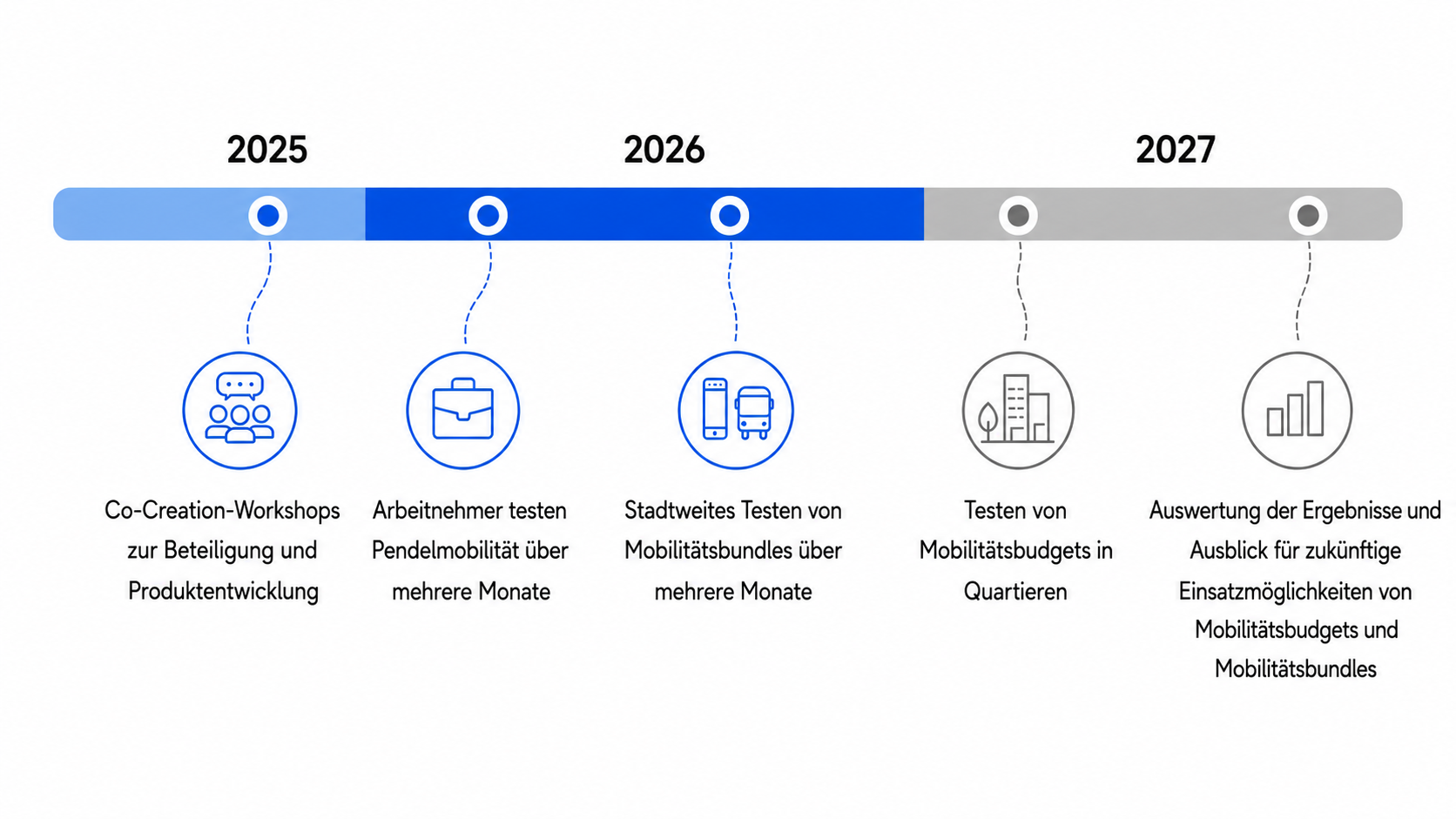
In the year 2025: The people in the district can participate. They can express their ideas. There are discussions, surveys and meetings. Researchers are also starting their work.
In the year 2026: Some ideas are tried out. They are moved around the streets for a certain period of time.
In the year 2027: The results are evaluated. Consideration is given to how things can continue∙.