A look into utopia sharpens our view of reality! (Feb. 23)

In the face of climate change and overcrowded roads, one thing is clear: we need to change our mobility behavior. To achieve this, people must become the focus of urban design. Like here on the Max-Josef Bridge in Munich. The contrast could not be greater: between the 8-lane road at the huge intersection and the lively urban utopia with a view directly onto the Isar. Designed for the MCube future cluster by Hamburg artist Jan Kamensky, who describes himself as a visual utopian. He playfully transforms car-friendly streets into people-friendly places, triggering a new awareness among viewers. They experience their neighborhood as car-free, green and worth living in. Afterwards, they return to reality with a sharpened view. With these utopian videos, Jan Kamensky wants to change the way we look at our way of life. First and foremost, they aim to expand the viewer's awareness and question their own mobility behavior. The feasibility of the utopias is of secondary importance.

These three Munich utopias was made possible by Jan Kamensky in collaboration with the future cluster MCube and its close partner Digital Hub Mobility by UnternehmerTUM.

Munich Utopia: Max Josef Brücke

Munich utopia: Candidplatz

Munich utopia: Sommerstraße in der Au

Develop the next mobility innovations for metropolitan regions. Together. Possible. To make it happen.

In 2025, representatives from various municipalities regularly met as part of a Community of Practice to exchange ideas on meaningful practices with urban data for sustainable mobility.

A recent study from the ReMIX environment investigates, through urban experiments in Munich, how specific mobility futures are made effective by three central performative mechanisms.

How can questions of equitable mobility be jointly researched and shaped? The seminar „Planning for Mobility Justice“ at the TU Munich highlights different perspectives on mobility (in)justice.

How can mobility innovations be designed responsibly — and what political frameworks are needed for this?

At re:publica 2026 in Berlin, MCube was represented at Europe's largest digital and society conference – with all 21 cluster and campus initiatives of the BMFTR.

5,000 guests, many insights: TUM's Sustainability Day made sustainable innovation tangible.

MCube Consulting is introducing SmartEvent, a digital tool that makes event registration in Munich easier and more efficient through the use of geodata.

The new study shows: Every euro invested in public transport in the MVV generates almost four times the economic value added.

Electric, autonomous, networked: The logistics industry is facing a major transformation. The MCube Speaker Series at the Deutsches Museum discussed how this future can become reality.

Easy language

What is MOSAIQ?
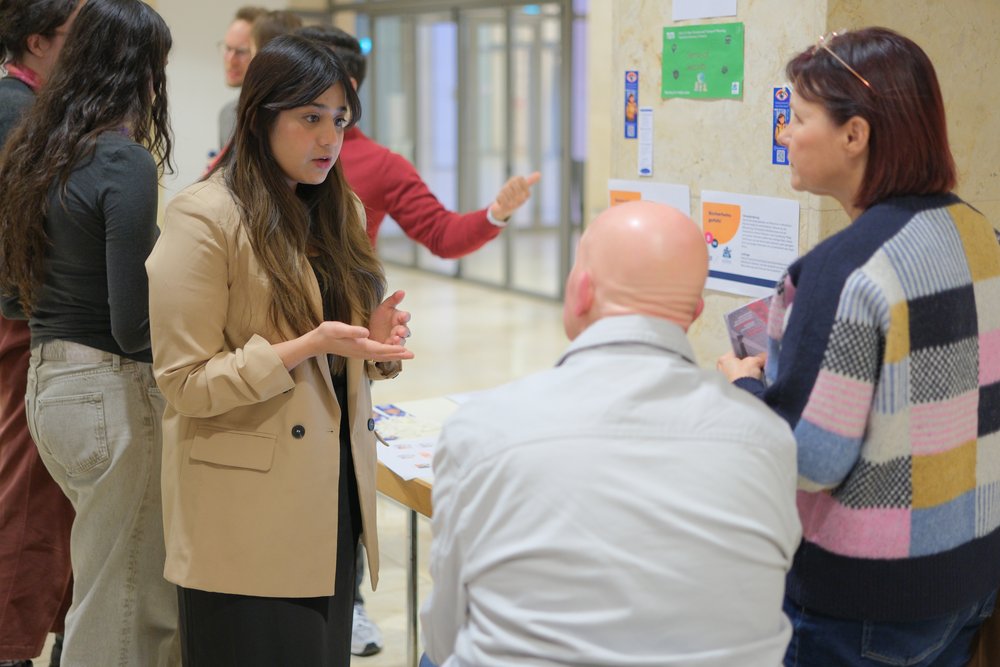
Imagine something: There is more space for people. The streets have more trees and plants. Everyone can get around better. That's how your Schwabing-West district could be in the future. How would you like your district to be? We want to talk to you about it!

The project is called MOSAIQ. MOSAIQ is a research∙project. MOSAIQ means: Mobility and urban climate in the future city∙part. The Technical University of Munich is leading the project.

What is MOSAIQ about?
MOSAIQ wants to make the streets in the city∙part more beautiful. People should feel comfortable there. There should be more space. For meetings and plants, for example. You can help decide what is tried out in the Stadt∙teil. The ideas come from you. Some ideas will be tried out on the streets for a certain period of time.
The aim of MOSAIQ is to make urban districts good places to live.
At the same time, the climate in the city should improve. And people should be able to move around the city easily. 

What is happening in the district?

  • In the year 2025:
    The people in the district can participate. They can express their ideas. There are discussions, surveys and meetings. Researchers are also starting their work.
  • In the year 2026:
    Some ideas are tried out.
    They are moved around the streets for a certain period of time.
  • In the year 2027:
    The results are evaluated.
    Consideration is given to how things can continue∙.