Newsletter from January 31, 2023
Just imagine: There would always be an electric vehicle waiting for you in a reserved parking space and a charging station in your underground garage - and you wouldn't even have to worry about cleaning and MOT yourself.
The only condition: You leave your own vehicle behind and share the vehicle pool provided with a fixed group of users from your house community. Doesn't that sound tempting?
This is exactly what is being investigated for some residents of a housing complex run by the non-profit housing association Gemeinnütziger Wohnungsverein München 1899 e.V. in Nymphenburg as part of the research project ComfficientShare will become a reality this year. One of the aims of the project is to find out how many private vehicles can be replaced by a car-sharing vehicle - without having to accept any loss of comfort in terms of individual mobility - and how the charging infrastructure for the vehicles can be integrated into the residential location.
In 2022, the project team found a suitable location and was able to recruit a diverse and, above all, motivated group of participants. In the first phase of the project, the mobility behavior of the participants was recorded with GPS transmitters in the fall.
The second project phase began in December 2022 and will continue until June 2023. In this phase, five households each received an electric vehicle for their sole use. The project is investigating the extent to which the type of drive has an impact on mobility behavior. Are people also traveling shorter distances by car because they are now supposedly "clean"?
The supposedly most exciting and final phase of ComfficientShare will begin shortly before the 2023 summer vacation. During this phase, five electric vehicles will be shared for nine months.
Will all participants want to go on vacation by car or hike in the mountains at the same time? Can we really do without vehicles without having to fundamentally change our mobility? We will find out!

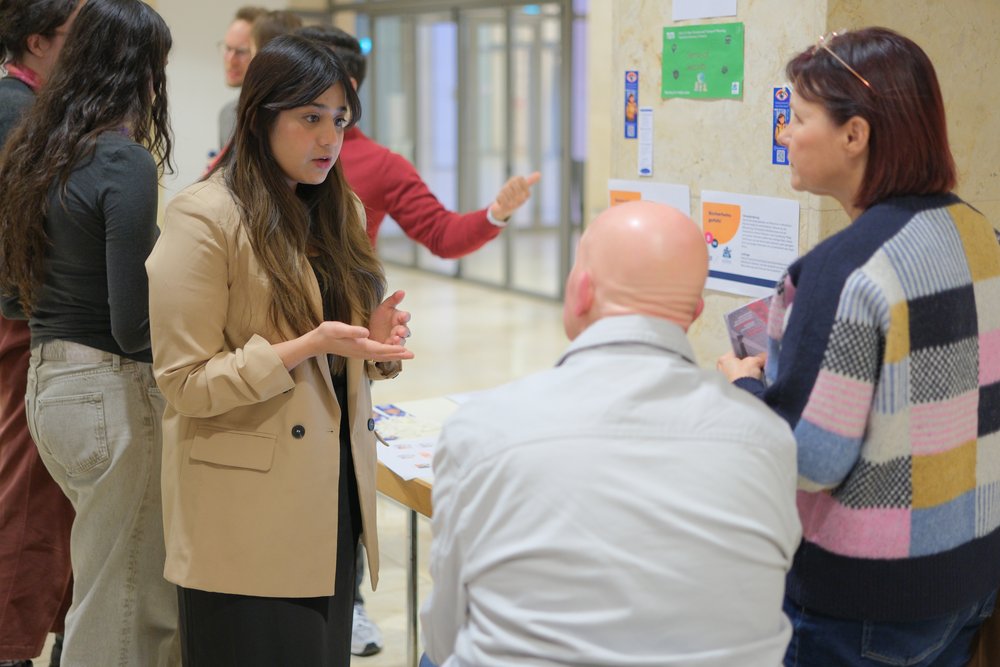
In 2025, representatives from various municipalities regularly met as part of a Community of Practice to exchange ideas on meaningful practices with urban data for sustainable mobility.
How can questions of equitable mobility be jointly researched and shaped? The seminar „Planning for Mobility Justice“ at the TU Munich highlights different perspectives on mobility (in)justice.
Develop the next mobility innovations for metropolitan regions. Together. Possible. To make it happen.
A recent study from the ReMIX environment investigates, through urban experiments in Munich, how specific mobility futures are made effective by three central performative mechanisms.
How can mobility innovations be designed responsibly — and what political frameworks are needed for this?
At re:publica 2026 in Berlin, MCube was represented at Europe's largest digital and society conference – with all 21 cluster and campus initiatives of the BMFTR.
5,000 guests, many insights: TUM's Sustainability Day made sustainable innovation tangible.
MCube Consulting is introducing SmartEvent, a digital tool that makes event registration in Munich easier and more efficient through the use of geodata.
The new study shows: Every euro invested in public transport in the MVV generates almost four times the economic value added.
Electric, autonomous, networked: The logistics industry is facing a major transformation. The MCube Speaker Series at the Deutsches Museum discussed how this future can become reality.
No results available
What is MOSAIQ?
Imagine something: There is more space for people. The streets have more trees and plants. Everyone can get around better. That's how your Schwabing-West district could be in the future. How would you like your district to be? We want to talk to you about it!
The project is called MOSAIQ. MOSAIQ is a research∙project. MOSAIQ means: Mobility and urban climate in the future city∙part. The Technical University of Munich is leading the project.
What is MOSAIQ about?
MOSAIQ wants to make the streets in the city∙part more beautiful. People should feel comfortable there. There should be more space. For meetings and plants, for example. You can help decide what is tried out in the Stadt∙teil. The ideas come from you. Some ideas will be tried out on the streets for a certain period of time.
The aim of MOSAIQ is to make urban districts good places to live.
At the same time, the climate in the city should improve. And people should be able to move around the city easily.
What is happening in the district?