WiPa -
Effective participation for mobility innovations
What is WiPa?
Imagine: Mobility innovations that are developed together with citizens, are met with understanding and have a long-term impact. How can participation and communication be designed in such a way that they enable genuine co-design?
This is exactly where WiPa comes in. WiPa stands for „Effective Participation for Mobility Innovations“ and supports the MCube innovation projects across the cluster in the development, implementation and evaluation of participation processes.
WiPa aims to systematically integrate participation and communication into MCube projects. Together with researchers, practitioners and citizens, we create space for constructive dialog and increase the scope for co-designing implementation projects.
How do we proceed?
WiPa continuously supports the MCube innovation projects with active citizen activation and innovative participation formats. We strengthen futures literacy, involve citizens in the brainstorming process at an early stage and impart methodological and process expertise to researchers and practitioners.
Through effective participation in the context of future mobility, we contribute to the success of the MCube projects - in the individual living labs and across the cluster.
The project focuses on the following areas:
Recognize needs
We identify participation needs in the innovation projects and in cluster management. We use matchmaking events, project-specific workshops, iterative needs assessments and an agile process design.
Shaping participation
We support communication with the public, moderate discourse and activate citizens and social actors through outreach and innovative participation formats. In this way, we enable informed opinion-forming, co-determination and strengthen futures literacy and self-efficacy.
Secure knowledge
We evaluate the participation projects, process the results and save key findings in lessons learned and a method toolbox. We pass on this knowledge to the specialist public and civil society and prepare the next MCube funding phase.
Dissemination / Publications
Dissmination
Lorem Ipsum
Lorem ipsum dolor sit amet, consetetur sadipscing elitr, sed diam nonumy eirmod tempor invidunt ut labore et dolore magna aliquyam erat, sed diam voluptua. At vero eos et accusam et justo duo dolores et ea rebum.
Lorem ipsum dolor sit amet, consetetur sadipscing elitr, sed diam nonumy eirmod tempor invidunt ut labore et dolore magna aliquyam erat, sed diam voluptua. At vero eos et accusam et justo duo dolores et ea rebum.
Lorem ipsum dolor sit amet, consetetur sadipscing elitr, sed diam nonumy eirmod tempor invidunt ut labore et dolore magna aliquyam erat, sed diam voluptua. At vero eos et accusam et justo duo dolores et ea rebum.
Experienced partners from science, administration, business and society work together in WiPa under the leadership of the Technical University of Munich.
Science
Chair of Settlement Structure and Transport Planning at the Technical University of Munich
At the Chair of Settlement Structure and Transport Planning at TUM, we research how cities or other forms of settlement and transport can be designed in such a way that all people can travel sustainably and reach their destinations with the shortest possible distances. We develop methods to find gaps in this accessibility and work together with society and practitioners to develop solutions for sustainable, livable and equitable urban development. In MCube Phase I, the Chair was involved in the real-world laboratory project aqt and other projects.
Munich University of Applied Sciences is one of the largest universities of applied sciences in Germany and offers practical training and applied research in engineering, economics, social sciences and design. It promotes innovative projects, practice-oriented teaching and cooperation with business, local authorities and research institutions. Through development projects in areas such as mobility, digitalization and sustainable urban development, the university contributes to the development of sustainable, efficient and socially relevant solutions.
The Mobility Department (MOR) is the central point of contact for all strategic issues relating to mobility and transportation in Munich. Our goal is equal and safe coexistence on our roads and a better quality of life in Munich.
USP Projekte GmbH is a consulting and project development company that supports municipalities, companies and institutions in the planning and implementation of infrastructure and mobility projects. With a focus on efficient, sustainable and practical solutions, we provide support from conception and feasibility studies through to implementation. In doing so, we promote the networking of stakeholders and the integration of innovative technologies in order to make urban mobility, transport planning and urban development fit for the future.
Society
Hans Sauer Foundation
The Hans Sauer Foundation is a non-profit foundation for the promotion of science and research. We are concerned with shaping social change, creating links between science, administration, business and civil society. By incorporating diverse perspectives and different stakeholders, we aim to contribute to socially sustainable knowledge.We do this through the use of participatory and co-creative methods.
Associated partners
German Museum
The Deutsches Museum in Munich is one of the largest science and technology museums in the world and conveys knowledge about science, technology and innovation. It showcases historical and current developments in areas such as energy, mobility, digitalization and sustainable technologies. Through exhibitions, experiments and educational programs, the museum makes research and technological innovations accessible to the public and promotes understanding of forward-looking solutions in business, society and urban mobility.
PB Consult - Planning and business consulting company mbH
PB Consult supports municipalities, companies and institutions in the development and implementation of infrastructure and mobility projects. With a focus on sustainable, efficient and future-proof solutions, we accompany projects from strategy and concept development through to implementation. With expertise in transport planning, digitalization and urban infrastructure, we promote the integration of innovative technologies and the optimization of mobility in cities and regions.
intrestik
intrestik creates test rooms in which abstract goals become concrete solutions. We bring people together, simulate the future and transform a „we should do it“ into „we'll take care of it“. This produces results that don't just work on paper. Everyone should be able to contribute to creating a better world. intrestik - future-proof through dialog.
experience consulting GmbH
Sustainable cultural development is complex. We make it faster, better and more effective. We think strategically, involve people and create tangible change. That is our formula for real transformation. When knowledge is lacking or communication is not effective, change processes come to a standstill. Dialogue creates understanding, trust grows and the process gets moving again. Participation is a central component of our approach. We include it in every project and make it a real success factor.
WiPa Team
Annette Kirschmann
Carolin Zimmer
David Roth
Dr. Silke Konsorski
Dr. Sonja Rube
Eric Treske
Franziska Groß
Judith Schwandner
Mathilda Hollreiser
Matthias Grundei
Melanie Settele
Michael Hauck
Nicolas Prinz
Prof. Dr. Eileen Mandir
Sebastian Preiß
There are no results matching your search
Become a part of MCube!
Are you interested in working with MCube? Then please get in touch with us.
Contact form
Easy language
What is MOSAIQ? Imagine something: There is more space for people. The streets have more trees and plants. Everyone can get around better. That's how your Schwabing-West district could be in the future. How would you like your district to be? We want to talk to you about it!
The project is called MOSAIQ. MOSAIQ is a research∙project. MOSAIQ means: Mobility and urban climate in the future city∙part. The Technical University of Munich is leading the project.
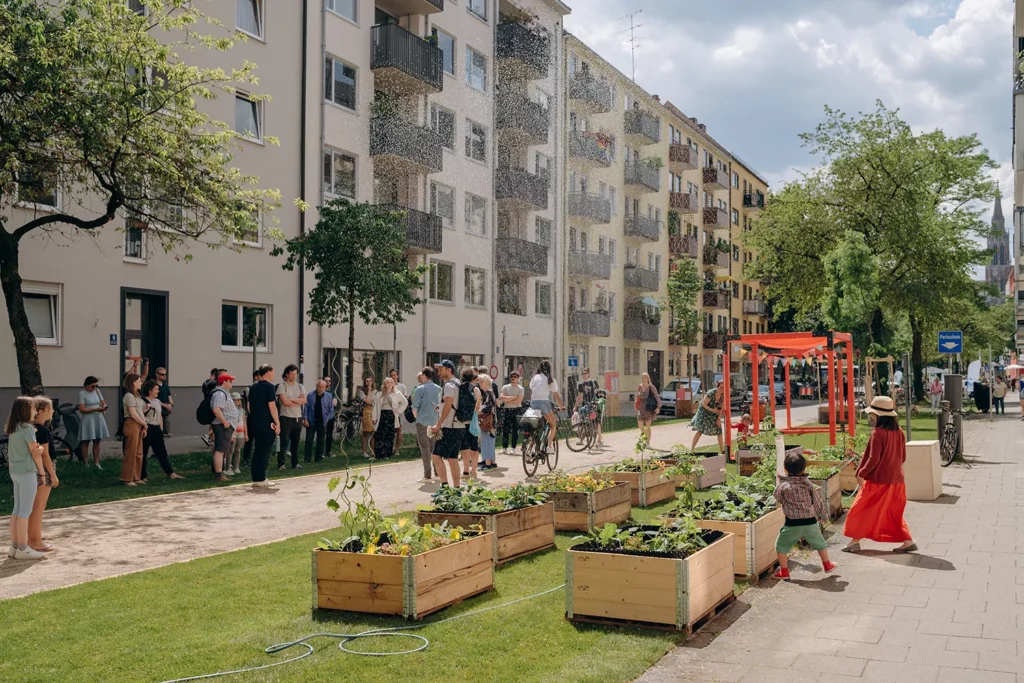
What is MOSAIQ about? MOSAIQ wants to make the streets in the city∙part more beautiful. People should feel comfortable there. There should be more space. For meetings and plants, for example. You can help decide what is tried out in the Stadt∙teil. The ideas come from you. Some ideas will be tried out on the streets for a certain period of time. The aim of MOSAIQ is to make urban districts good places to live. At the same time, the climate in the city should improve. And people should be able to move around the city easily.
What is happening in the district?
In the year 2025: The people in the district can participate. They can express their ideas. There are discussions, surveys and meetings. Researchers are also starting their work.
In the year 2026: Some ideas are tried out. They are moved around the streets for a certain period of time.
In the year 2027: The results are evaluated. Consideration is given to how things can continue∙.