Lorem ipsum dolor sit amet, consetetur sadipscing elitr, sed diam nonumy eirmod tempor invidunt ut labore et dolore magna aliquyam erat, sed diam voluptua. At vero eos et accusam et justo duo dolores et ea rebum.
Lorem ipsum dolor sit amet, consetetur sadipscing elitr, sed diam nonumy eirmod tempor invidunt ut labore et dolore magna aliquyam erat, sed diam voluptua. At vero eos et accusam et justo duo dolores et ea rebum.
Lorem ipsum dolor sit amet, consetetur sadipscing elitr, sed diam nonumy eirmod tempor invidunt ut labore et dolore magna aliquyam erat, sed diam voluptua. At vero eos et accusam et justo duo dolores et ea rebum.
ReMIX - Responsible Mobility Innovation and Experimentation
What is ReMIX?
How can mobility be designed to be socially just, ecologically sustainable, and economically viable? ReMIX pools expertise and know-how within the cluster and supports the dissemination of this knowledge externally. To support different stakeholder groups in the mobility transformation, we build bridges between research and practice, politics and administration.
ReMIX supports governance structures and experimental spaces: We promote clear decision-making processes in cities and municipalities and support real-world laboratories to test new mobility solutions under real conditions and implement them responsibly.
ReMIX provides scientifically based insights and practical tools to help public administrations, companies, and academia successfully implement innovative mobility projects, always with society and people in mind. We consider urban and rural contexts and support the scaling of successful approaches.
ReMIX works with a holistic approach: scientific knowledge, practical tools and experience from real-world laboratories are pooled, documented and made available to local authorities.
We focus on the following areas:
Guidelines for integrated mobility planning
We are developing a practical guide for mobility planning and data governance in the Munich metropolitan region, based on the MCube ecosystem. Municipalities will receive concrete support for the implementation of sustainable and data-driven mobility solutions.
Real Laboratory Atlas
We are developing an analytical representation scheme for real-world mobility laboratories with various goals and approaches. As a digital platform, the Atlas of Real-World Laboratories is intended to document the region and potentially beyond, providing information on methods, partners, and experiences. This way, the Atlas can serve as a communication tool and facilitate an overview of future real-world laboratory projects.
Coaching for Living Labs
We are developing a transferable coaching concept for innovation projects that individually addresses challenges. The foundation is the social science findings from ReMIX and the predecessor projects TrEx and ReMGo on responsible real-world laboratories. The coaching sessions cover ethical, societal, ecological, and political issues.
Policy Dialogue and Knowledge Exchange
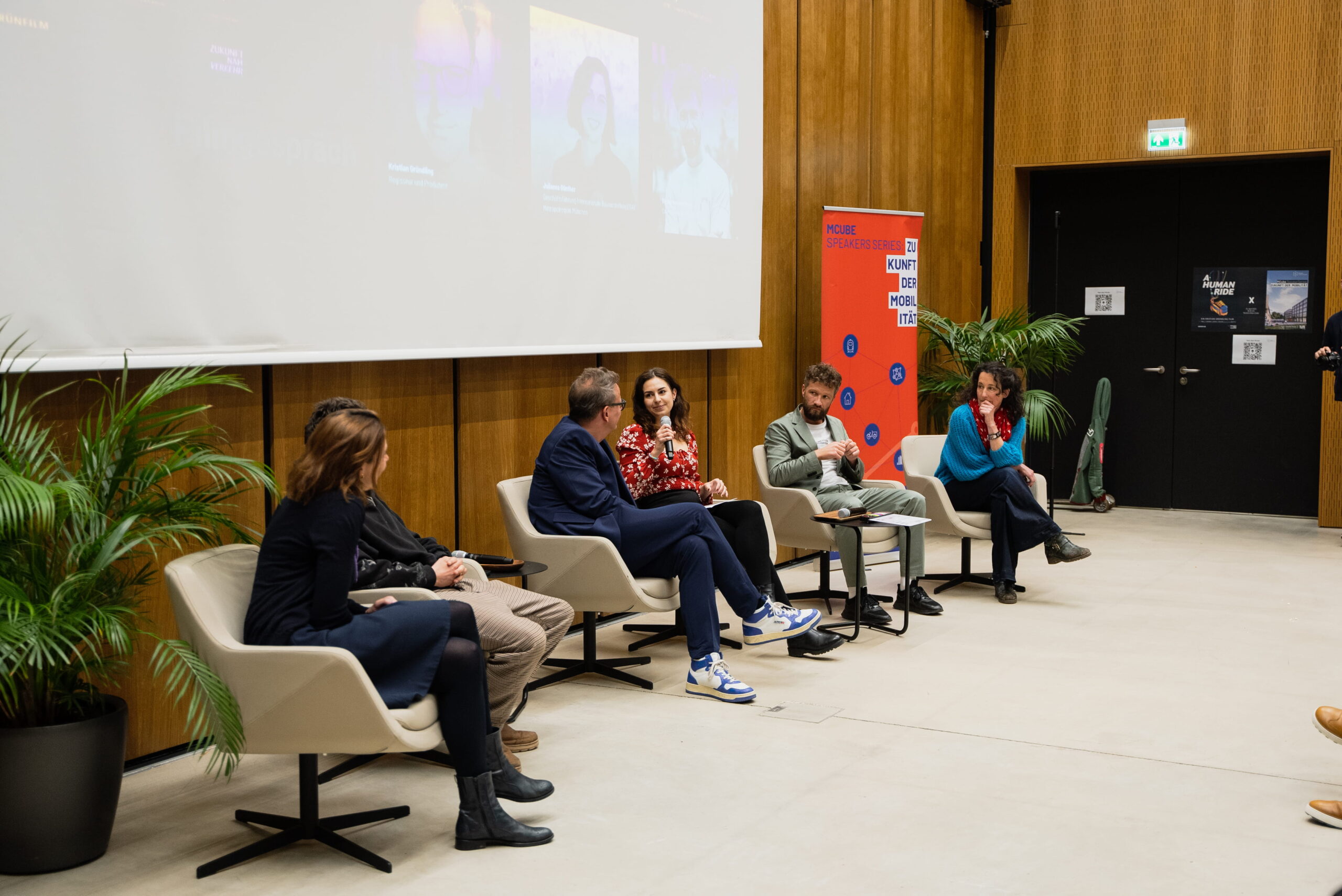
Regular events such as the „Political Breakfast“ or the „ReMIX Dialogue“ promote exchange between academia, administration, business, and politics, and form the basis for the development of practice-oriented recommendations for action.
European Case Studies
We analyze good practice examples from European metropolitan regions in order to prepare successful strategies and governance models for municipalities in an understandable way.
Data Governance in Practice
We develop recommendations for the responsible use of mobility data to ensure transparency, data protection and effective data processing in urban and mobility planning.
In 2025, representatives from various municipalities regularly met as part of a Community of Practice to exchange ideas on meaningful practices with urban data for sustainable mobility.
How can questions of equitable mobility be jointly researched and shaped? The seminar „Planning for Mobility Justice“ at the TU Munich highlights different perspectives on mobility (in)justice.
A recent study from the ReMIX environment investigates, through urban experiments in Munich, how specific mobility futures are made effective by three central performative mechanisms.
ReMIX supports innovation projects for political or societal challenges with expertise in political communication and consulting.
Support for integration into public planning and decision-making processes
ReMIX assists innovation projects with strategy development, for example, regarding the question of whether a project influences or changes existing planning.
Support for the publication of recommendations for action
We help sharpen target group-oriented messages and recommendations for action. Together with the innovation projects, we define and address specific target groups and develop policy briefs, guidelines, and recommendations for action.
We support innovation projects in shaping mobility innovation and real-world laboratories responsibly and embedding them in society. We do this by addressing ethical, social, and environmental issues in a practical and individualized manner.
Real Laboratory Atlas Munich
We are documenting real-world laboratories and their design approaches in a digital atlas. The visualizations serve as a communication tool within municipalities and with the public.
We support innovation projects in their work with data spaces by developing best practices, preparing existing concepts, and providing consulting with actionable recommendations.
Municipal transfer
We are developing interactive formats for transferring the acquired insights to municipalities. In doing so, we are focusing particularly on data utilization and the exchange of data between municipal actors and data hubs.
Our publications
Scientific publications, practice-oriented recommendations, and innovative approaches
In ReMIX, chairs of the Technical University of Munich work together with acatech – National Academy of Science and Engineering.
Science
Professorship for Innovation Research at the Technical University of Munich
At the Professorship for Innovation Research at TUM, we research the social, political, ethical, and epistemic foundations and consequences of mobility innovation – together with citizens, municipalities, and practice partners. In workshops, real-world labs, and dialogue formats, we develop ideas for sustainable mobility that is oriented towards people's needs.
At the Chair of Environmental and Climate Policy at TUM, we research the political, legal, and societal frameworks for environmental and climate protection. We develop evidence-based Recommendations for administration, politics, and businesses to implement sustainable strategies in areas such as energy, mobility, and urban development. We combine scientific analyses with practical projects and support decision-makers in shaping climate-positive and future-proof solutions.
acatech - National Academy of Science and Engineering.
acatech – The German National Academy of Science and Engineering advises politics and society on technological developments, innovations, and their societal impacts. The Academy promotes evidence-based Decisions, particularly in the areas of digitalization, mobility, energy, and urban development. Through expert opinions, studies, and dialogue formats, acatech supports the design of future-proof, sustainable, and technologically sound solutions for business, administration, and research.
ReMIX Team
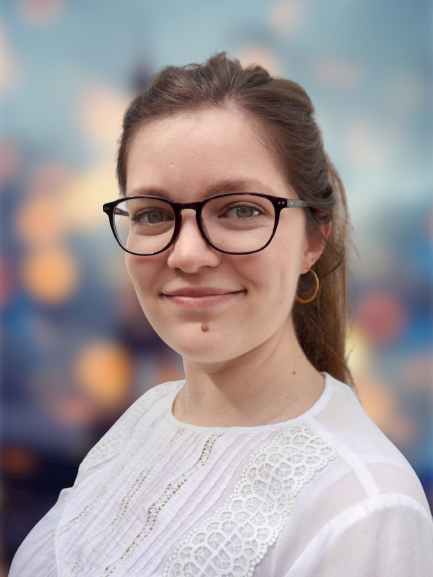
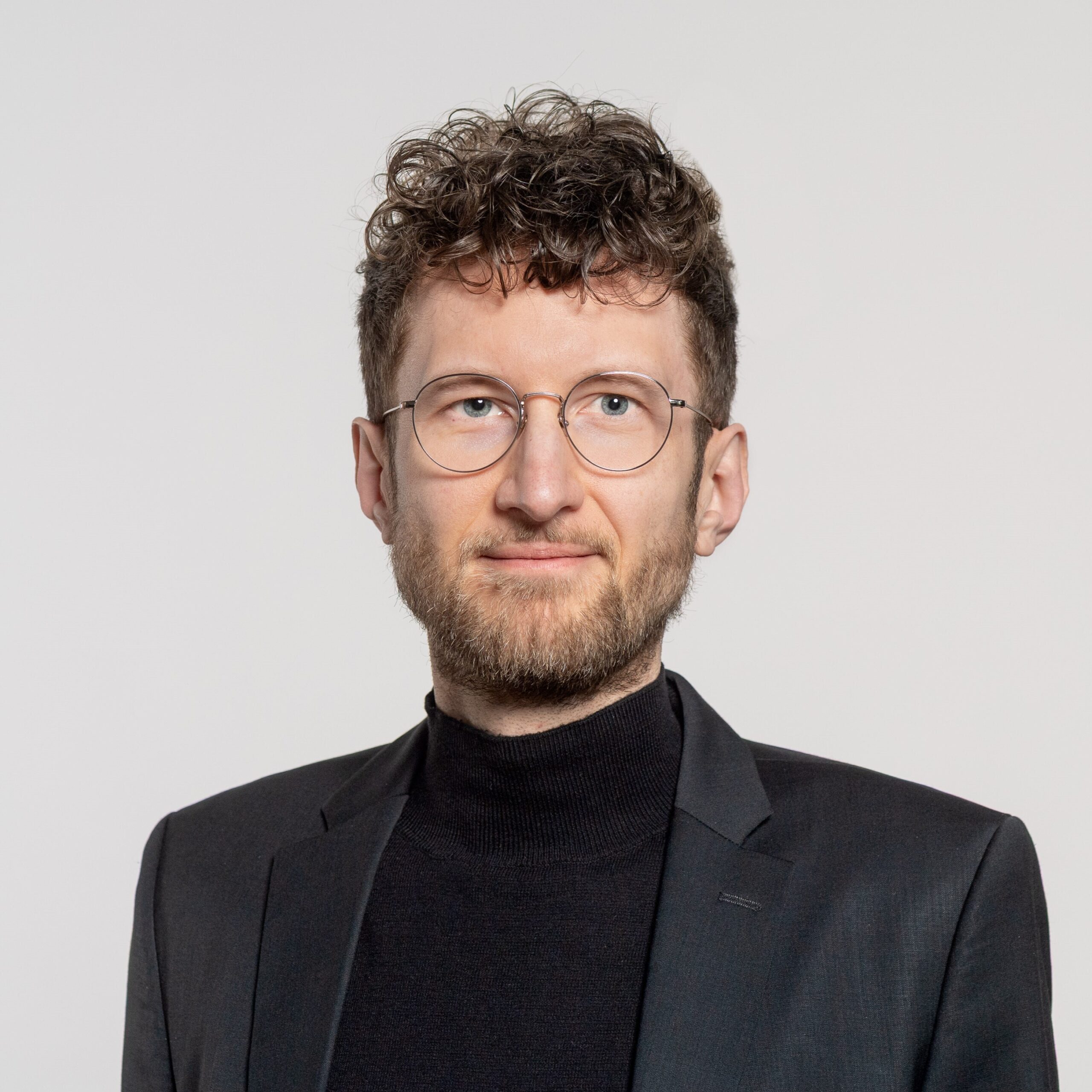
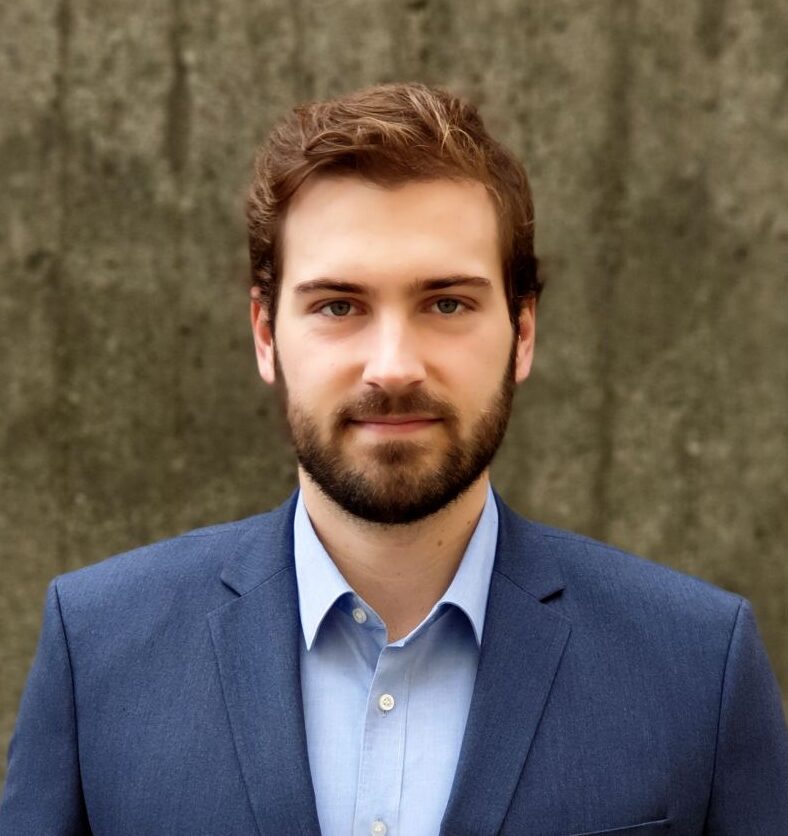
Alina Weiss
Bianca Balta
Dr. Alexander Wentland
Johannes Horvath
Manuel Jung
Patrick Diel
Prof. Dr. Miranda Schreurs
Prof. Dr. Sebastian Pfotenhauer
Sophia Knopf
Yulika Zebuhr
There are no results matching your search
Become a part of MCube!
Are you interested in working with MCube? Feel free to get in touch with us then.
Contact form
Easy language
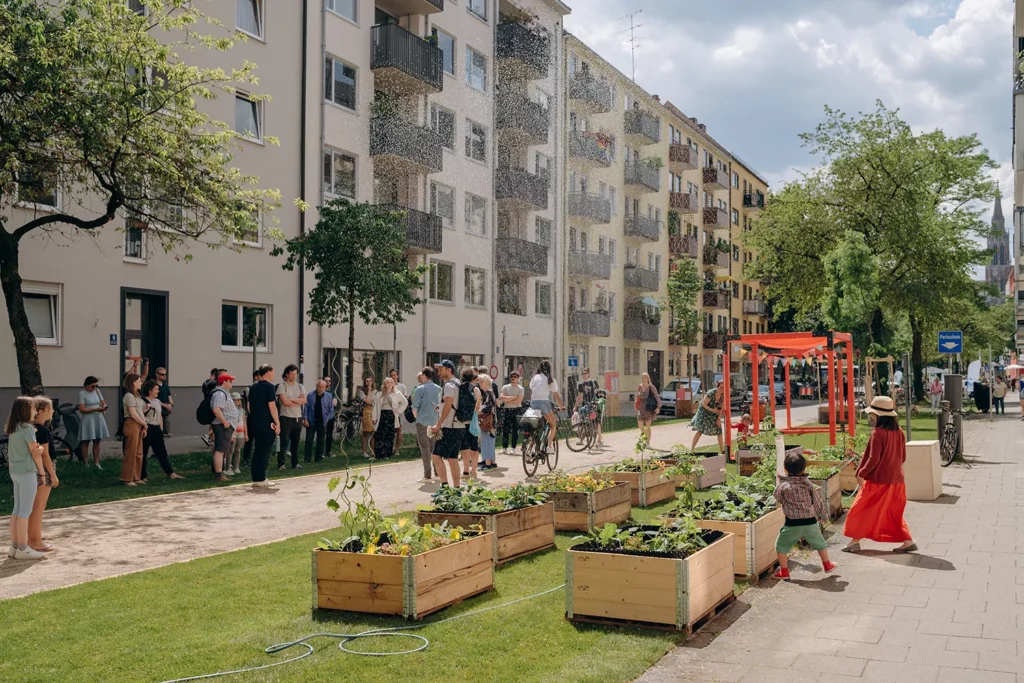
What is MOSAIQ? Imagine something: There is more space for people. The streets have more trees and plants. Everyone can get around better. That's how your Schwabing-West district could be in the future. How would you like your district to be? We want to talk to you about it!
The project is called MOSAIQ. MOSAIQ is a research∙project. MOSAIQ means: Mobility and urban climate in the future city∙part. The Technical University of Munich is leading the project.
What is MOSAIQ about? MOSAIQ wants to make the streets in the city∙part more beautiful. People should feel comfortable there. There should be more space. For meetings and plants, for example. You can help decide what is tried out in the Stadt∙teil. The ideas come from you. Some ideas will be tried out on the streets for a certain period of time. The aim of MOSAIQ is to make urban districts good places to live. At the same time, the climate in the city should improve. And people should be able to move around the city easily.
What is happening in the district?
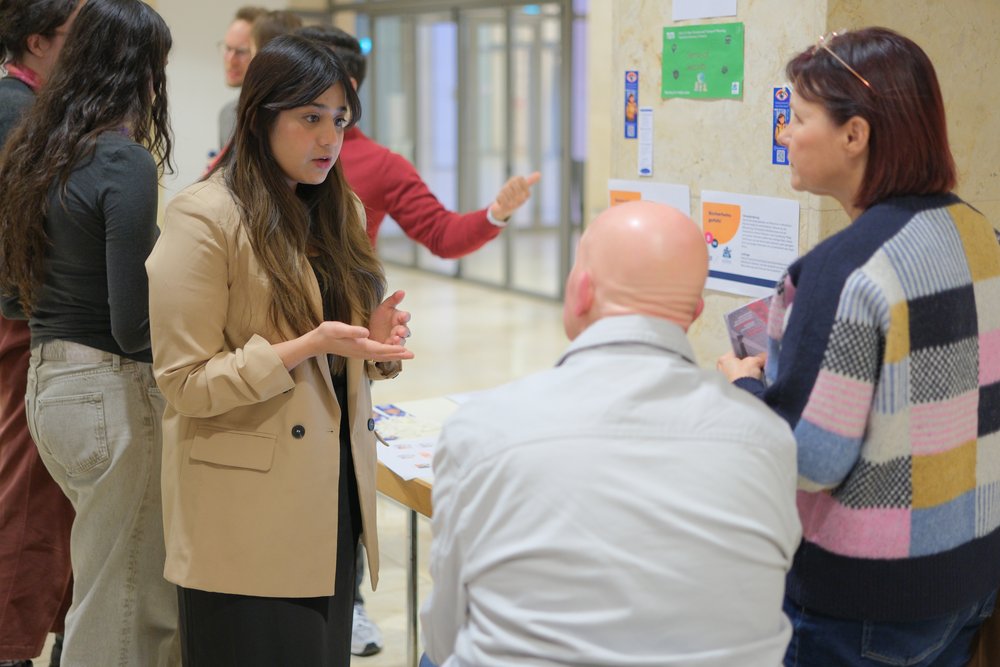
In the year 2025: The people in the district can participate. They can express their ideas. There are discussions, surveys and meetings. Researchers are also starting their work.
In the year 2026: Some ideas are tried out. They are moved around the streets for a certain period of time.
In the year 2027: The results are evaluated. Consideration is given to how things can continue∙.