The MOSAIQ Ideas Forum took place in the project quarter in Schwabing-West from September 17 to December 4, 2025. During this time, citizens, with the support of experts, developed project outlines from the submitted ideas. Subsequently, a jury selected the most promising proposals.
These will now become reality! Starting at the end of July 2026, the time-limited implementation of the selected measures will commence for approximately one year. It will begin at Apianplatz. Construction at Apianplatz and Fallmerayerstraße will take place in sections and is expected to be completed by mid-September 2026. During the winter, the measures will be adapted to be winter-proof. Optional additions and adjustments to the measures are planned from April 2027. It is planned for the measures to remain in place until around mid-September 2027.
You want to know how the idea forum went? Here Learn more.
MOSAIQ thrives on the participation of everyone in the neighborhood. There are many different ways to get involved in various formats - every input is important. Together, we can develop solutions that meet as many different needs of local residents and stakeholders as possible.
There are currently no new posts
The mobility of tomorrow affects us all. Whether sustainable transport planning, innovative technologies or smart solutions for urban and rural areas - the challenges are many and varied.
Do you have questions about the mobility of the future? Are you facing specific problems in your municipality, your company or your research? Our cluster brings together science, business, society and the public sector to find answers together.
In MOSAIQ, we are interested in the interface between mobility and urban climate. By urban climate, we mean both the climate in the meteorological sense and the climate among ourselves, i.e. how we live together in the city. Specifically, we are addressing this interface by testing and implementing measures in real-world laboratories in two Munich neighborhoods together with citizens that strengthen environmentally friendly forms of mobility, participation and social inclusion as well as quality of stay and climate resilience in the city - for a better quality of air, time and space, and for more social, land and climate justice
The mobility of tomorrow affects us all. Whether sustainable transport planning, innovative technologies or smart solutions for urban and rural areas - the challenges are many and varied.
Do you have questions about the mobility of the future? Are you facing specific problems in your municipality, your company or your research? Our cluster brings together science, business, society and the public sector to find answers together.
In MOSAIQ, we are interested in the interface between mobility and urban climate. By urban climate, we mean both the climate in the meteorological sense and the climate among ourselves, i.e. how we live together in the city. Specifically, we are addressing this interface by testing and implementing measures in real-world laboratories in two Munich neighborhoods together with citizens that strengthen environmentally friendly forms of mobility, participation and social inclusion as well as quality of stay and climate resilience in the city - for a better quality of air, time and space, and for more social, land and climate justice
The mobility of tomorrow affects us all. Whether sustainable transport planning, innovative technologies or smart solutions for urban and rural areas - the challenges are many and varied.
Do you have questions about the mobility of the future? Are you facing specific problems in your municipality, your company or your research? Our cluster brings together science, business, society and the public sector to find answers together.
In MOSAIQ, we are interested in the interface between mobility and urban climate. By urban climate, we mean both the climate in the meteorological sense and the climate among ourselves, i.e. how we live together in the city. Specifically, we are addressing this interface by testing and implementing measures in real-world laboratories in two Munich neighborhoods together with citizens that strengthen environmentally friendly forms of mobility, participation and social inclusion as well as quality of stay and climate resilience in the city - for a better quality of air, time and space, and for more social, land and climate justice
Events
Last year, ideas for greater quality of stay, greenery, and mobility for everyone were developed together with citizens in the project district in Schwabing-West. Subsequently, a jury selected the most promising proposals. These have now become a reality: There emerged more greenery, higher quality of stay, and improved traffic safety on Fallmeraystraße and Apianplatz.
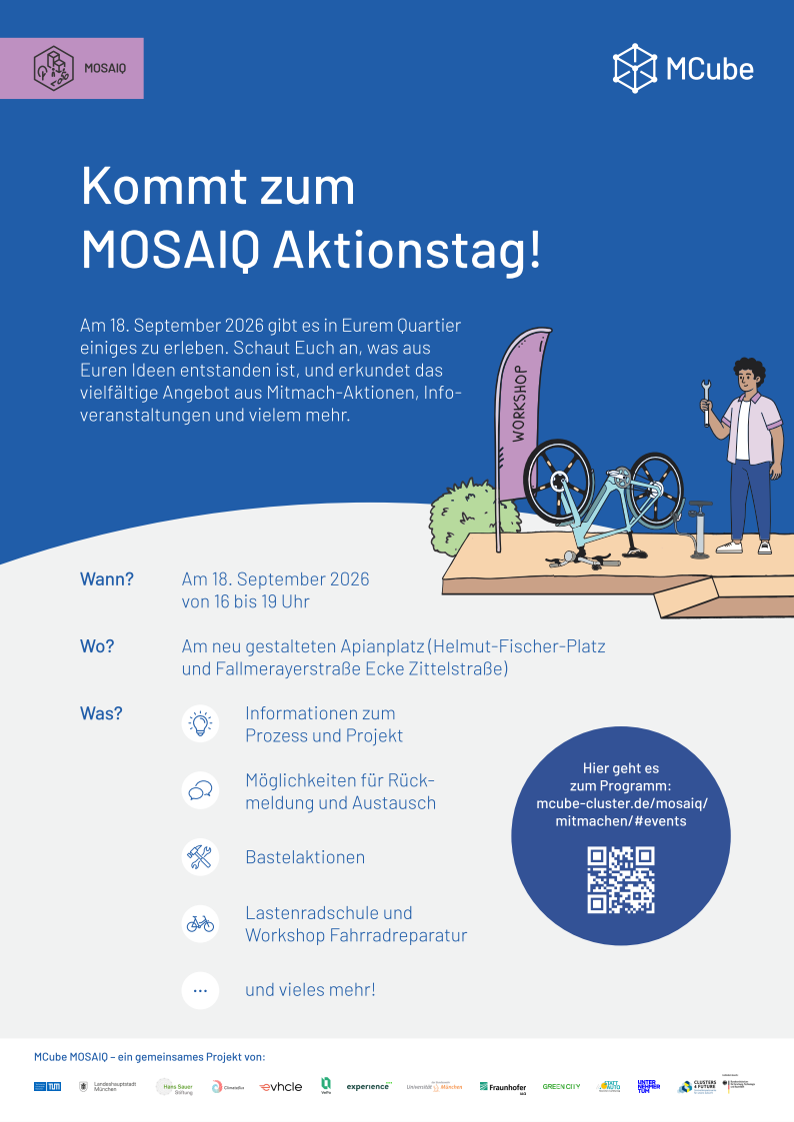
Are you curious to see what that looks like on-site in the neighborhood? Would you like to try out different uses of the temporary redesigns? Then drop by on the action day on Friday, September 18, 2026, from 4:00 PM to 7:00 PM! A diverse program awaits you. More information will follow here shortly.
The event is aimed at all local residents, initiatives, and interested parties. We look forward to the exchange!
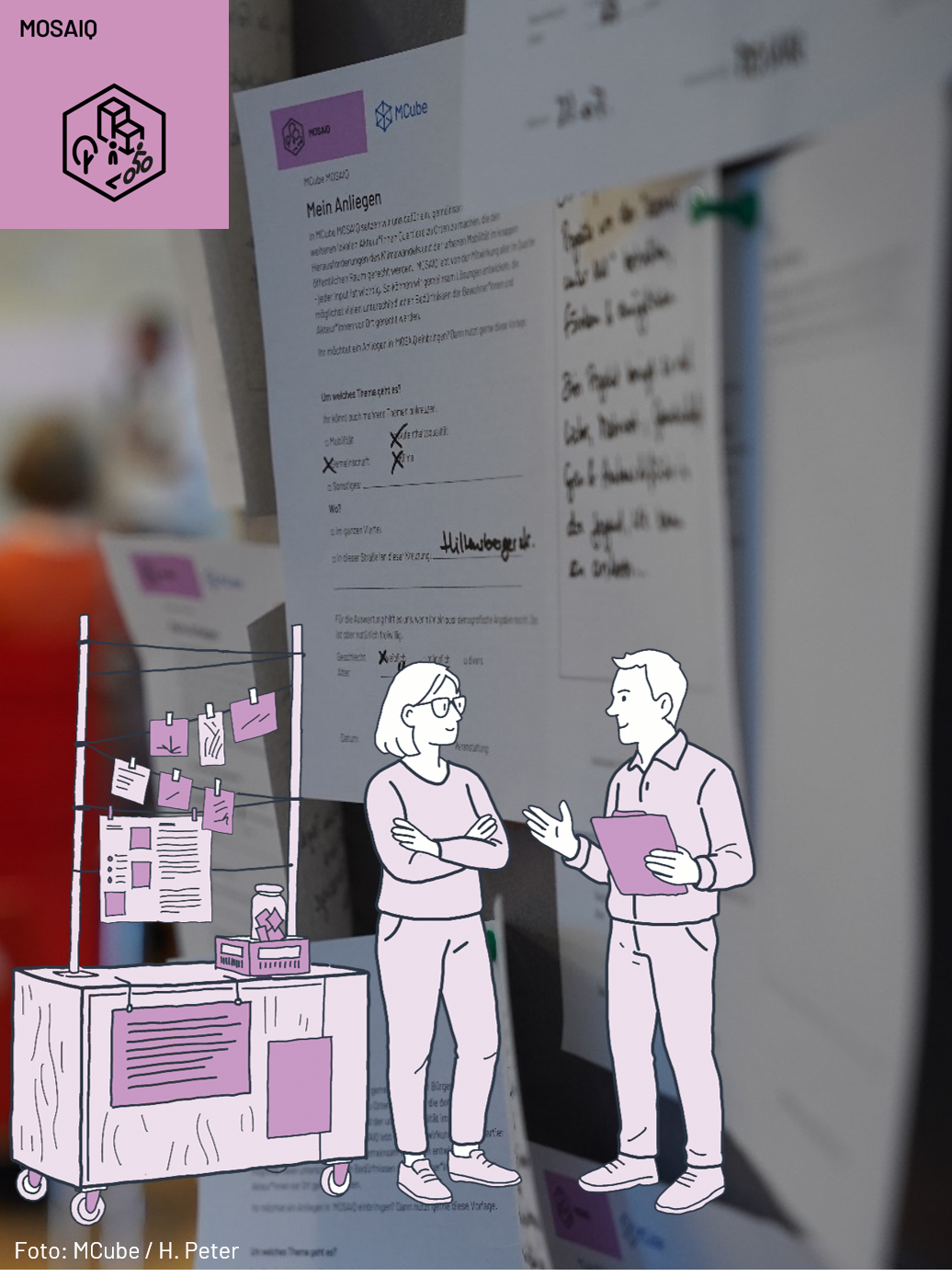
Do you want to know what's happening in Project MOSAIQ? Do you have questions or comments about the planned time-limited measures?
Come by and chat with the project team – regularly on-site in your neighborhood.
You can find us in Schwabing-West on the following dates:
More dates to follow.
We look forward to seeing you!
There are no results matching your search
Latest news
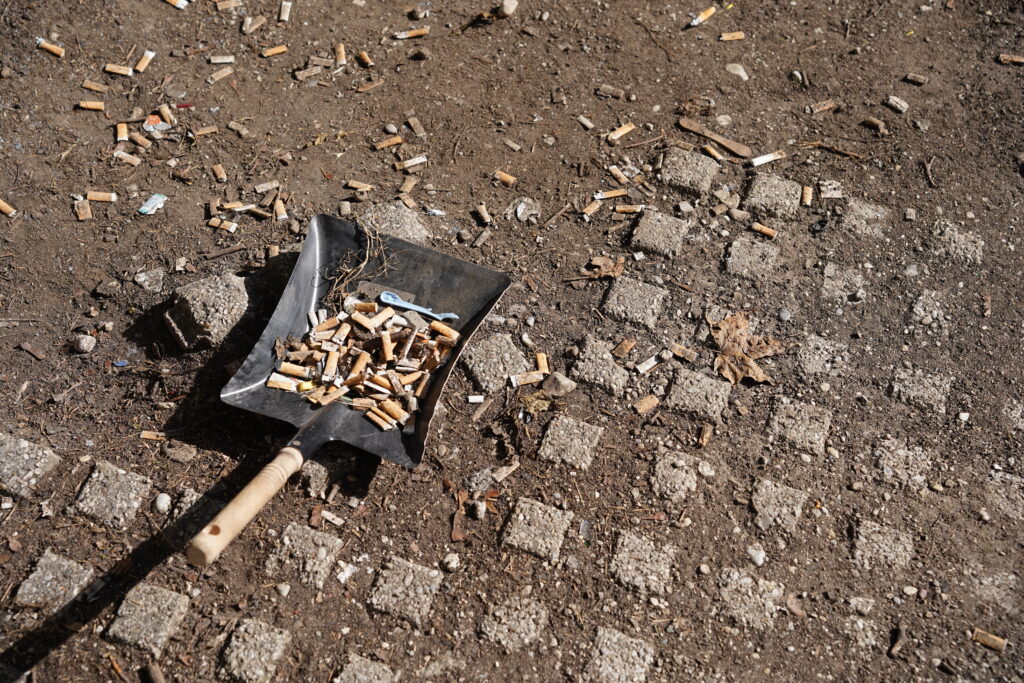
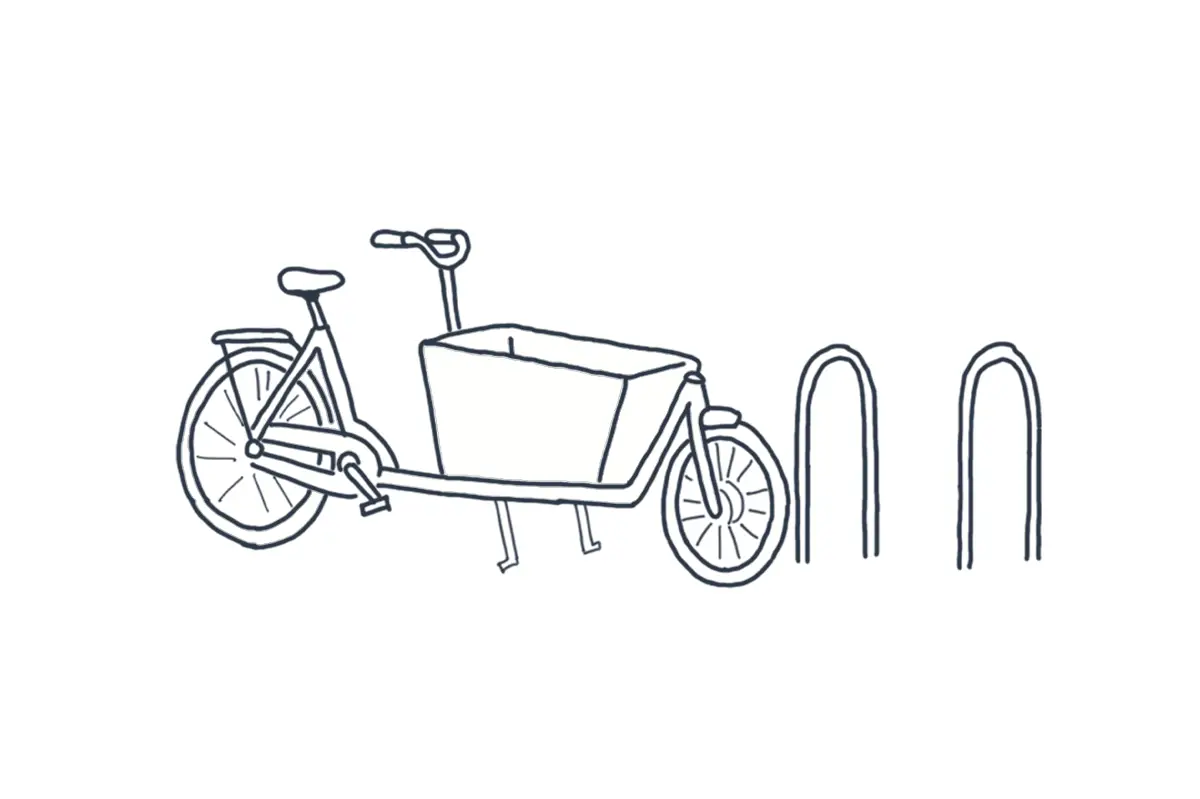
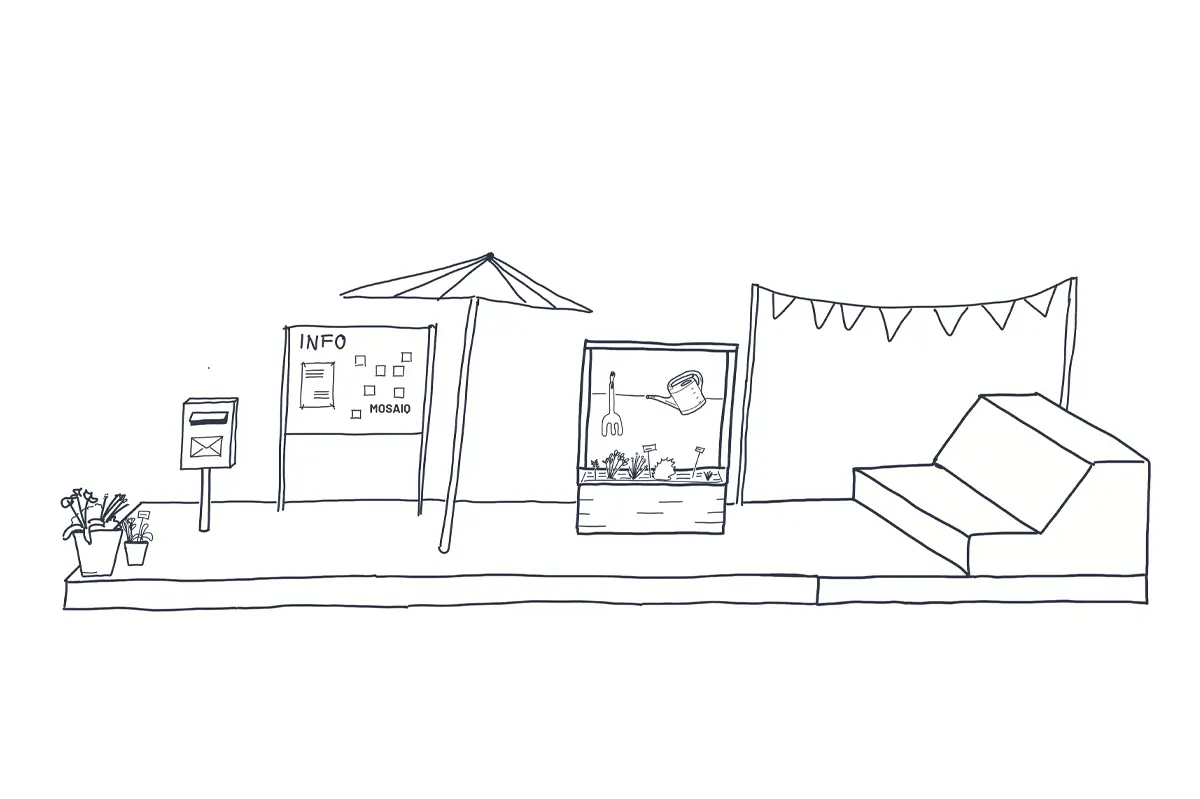
At the so-called „Apianplatz“ on the corner of Clemensstraße and Apianstraße, a bicycle repair station and a lounge area with seating have been available since July 2026, which were developed using your ideas and are now being implemented for a limited time. Soon, deck chairs, among other things, are to follow, which you can use to relax on the green space. To make it as nice as possible for you there, a litter cleanup event took place on Wednesday, August 26, 2026. Together, we cleared the green space of waste. Thank you to all helping hands for the support!
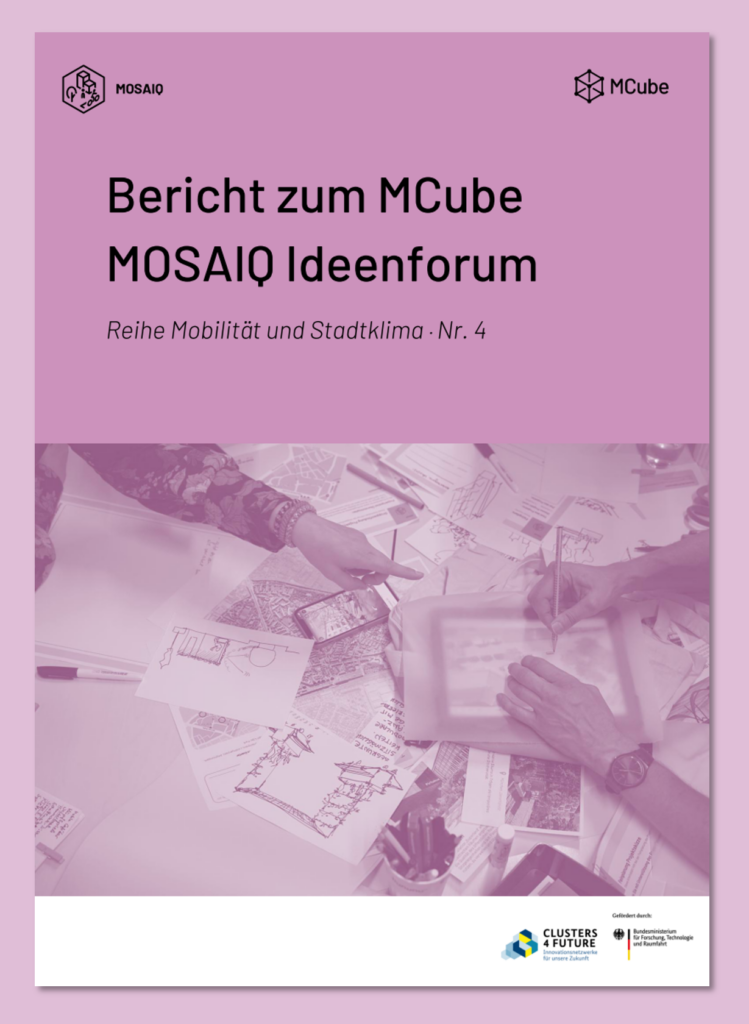
The latest edition of the “Mobility and Urban Climate” series is online. The „Report on the MCube MOSAIQ Ideas Forum“ explains the process of the ideas forum in detail. As accompanying material, the submitted idea profiles and project outlines are now also accessible in a prepared format. The series presents working results from research and teaching related to the MCube innovation project „Mobility and Urban Climate in the Future District“ (MOSAIQ) to the interested (professional) public.
All further information can be found here: https://mcube-cluster.de/mosaiq/mitmachen/#ideenforum. Enjoy reading!
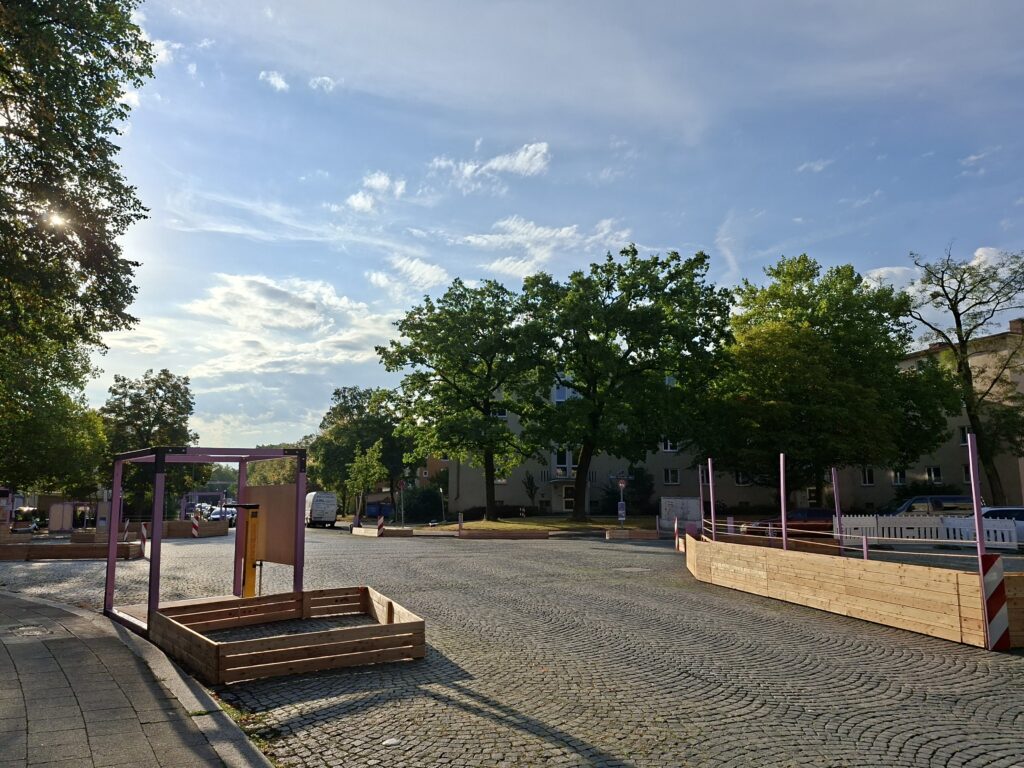
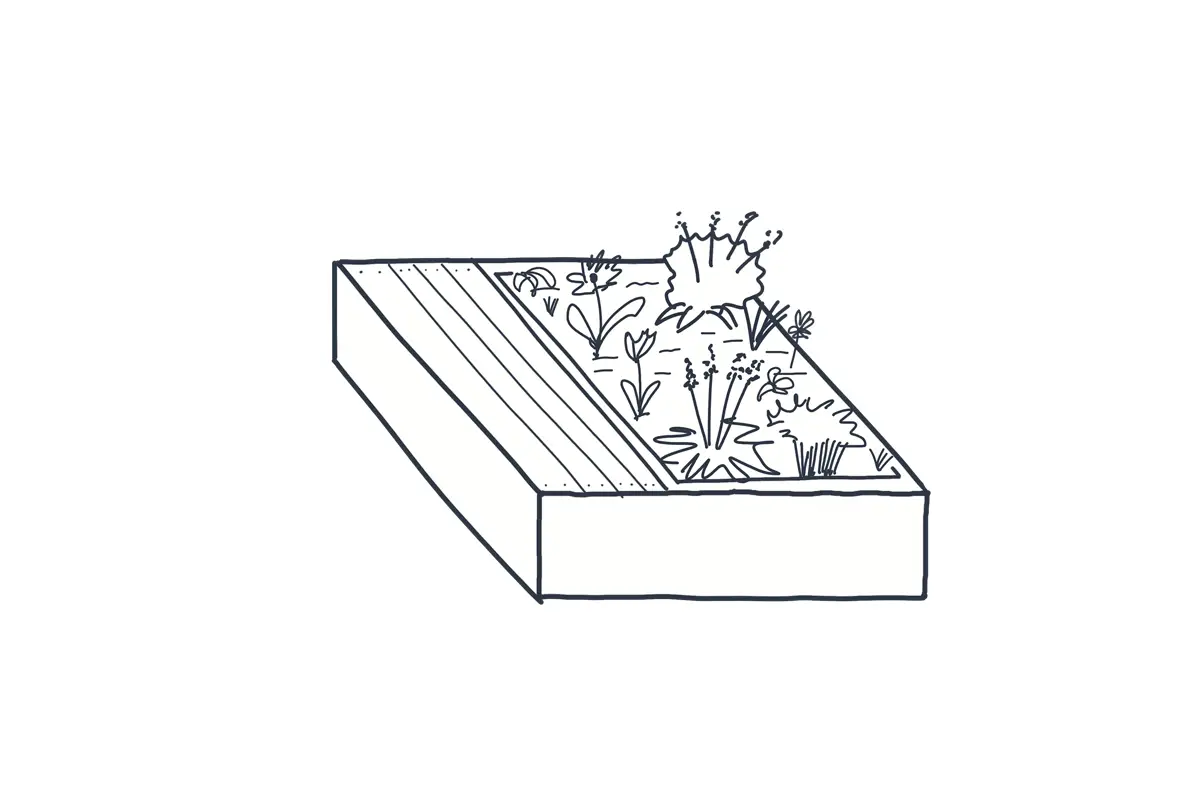
In Moosach, the installation of the temporary measures has begun: The intersection of Nanga-Parbat-Straße, Hugo-Troendle-Straße, and Karlingerstraße is being redesigned. Expanded sidewalk areas and clearer crossings are intended to improve safety for pedestrians and cyclists. At the same time, green meeting areas with seating, planting zones, and raised beds are being created. In addition, existing walkways in the surrounding residential estate are being better connected with one another. New, clearly recognizable crossing aids are being created around the Amphionpark primary school. Colorful installations are intended to mark the crossings, increase visibility, and ensure that the crossing areas are kept clear.
The construction is carried out in sections and is scheduled to be completed by mid-September. The measures are planned to remain in place until approximately mid-September 2027.
There are no results matching your search
Schwabing-West is the most densely populated district in Munich.
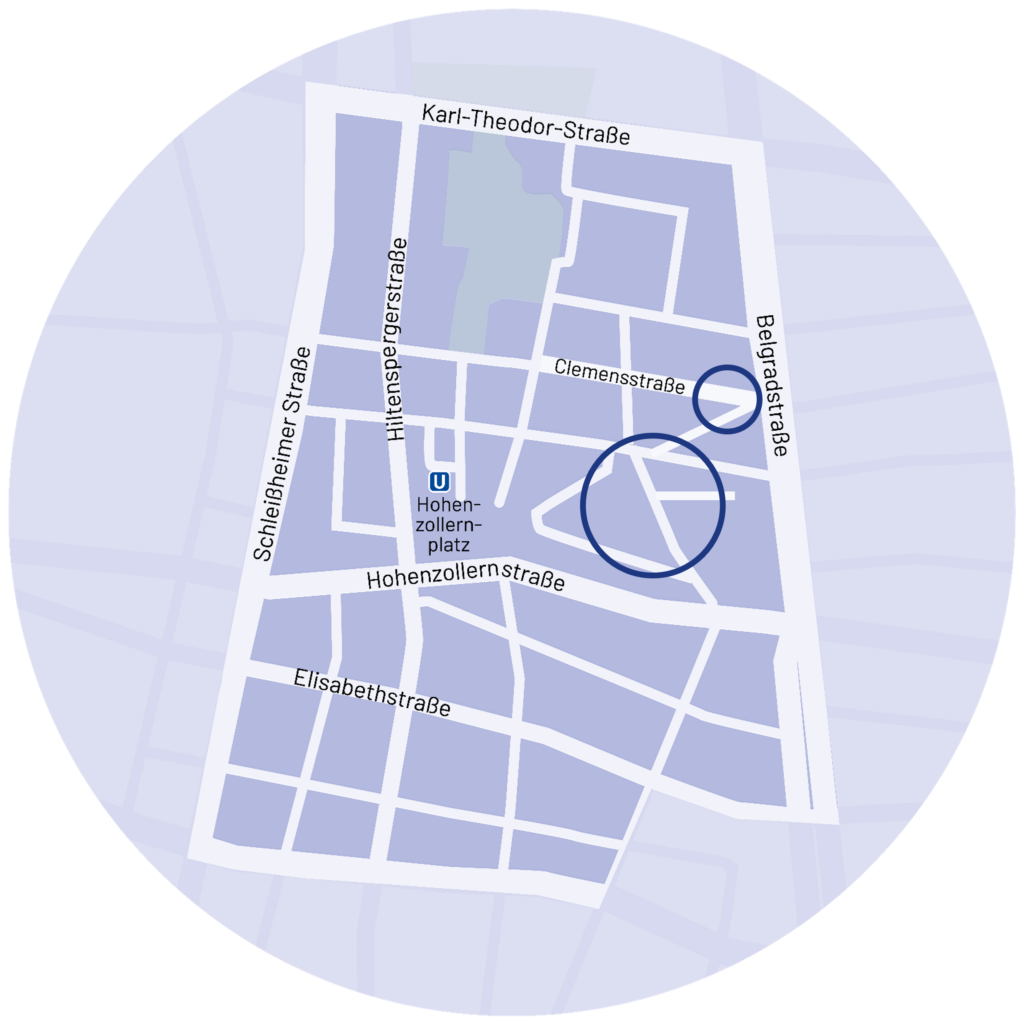
The project quarter, located in the city district, is characterized by closed-off blocks of buildings with many well-preserved old structures. In addition to residential use, there are a variety of social services, restaurants, and shops. The Elisabeth, Kurfürsten, and Hohenzollern Plazas are central gathering spots that were established during the Gründerzeit.
The district has been heavily densified over the past decades. As a result, open spaces have been lost and many have been sealed. As a result, the district now heats up more than other places in the summer months. Temperature measurements in recent years show that it can get particularly hot in Schwabing-West. It is therefore important to implement measures to adapt to the climate in order to increase the quality of outdoor life, especially in summer, or to allow people to cool down at night. The urban climate analysis of the City of Munich shows that the few existing green spaces only make a limited contribution to improving the climate in the residential areas, which are comparatively heavily burdened by heat in Schwabing-West (moderate to high bioclimatic burden).
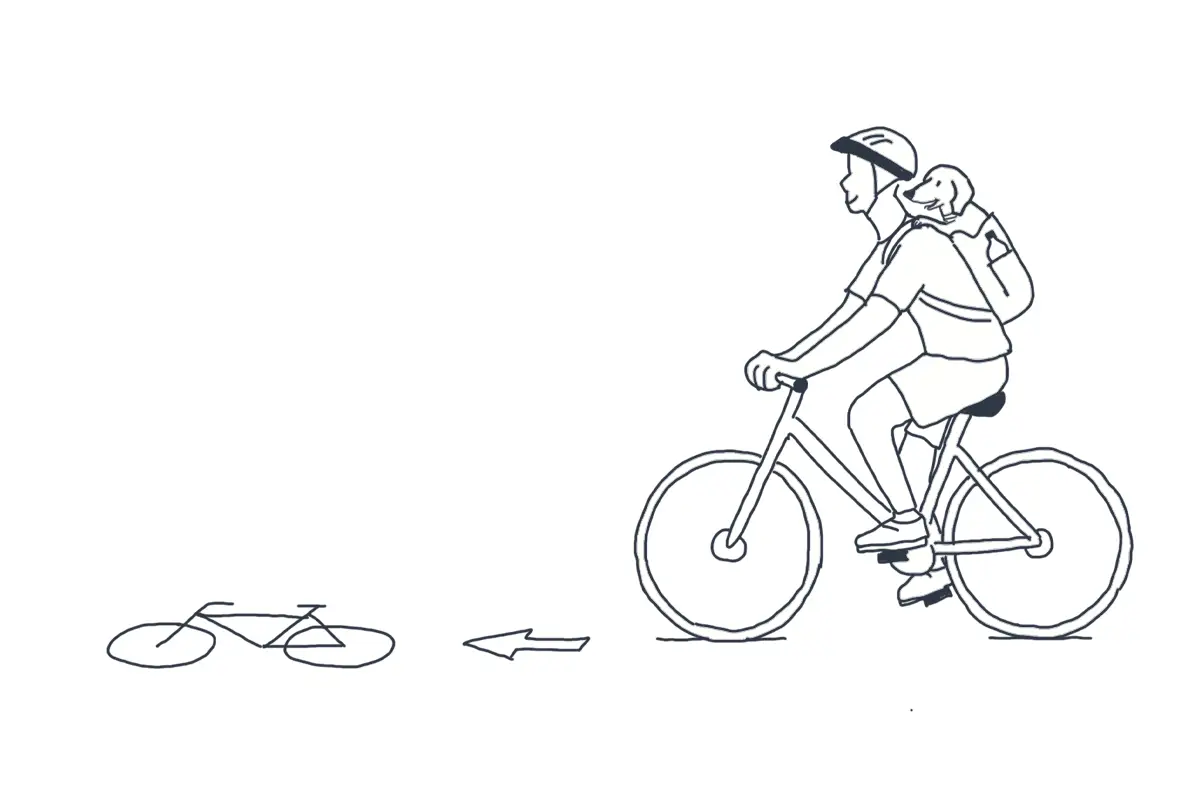
There is also a need for action in the area of mobility. In many places, the densely populated district has streets that are primarily geared towards car traffic. At the same time, the choice of means of transportation shows that residents of the Schwabing West district walk and cycle a lot. Together, these two modes of transportation now account for 63 percent of all trips. In addition, the Schwabing-West district is very well connected to public transport thanks to two subway lines and several streetcar and bus lines. 21 percent of journeys are made by residents using public transport. As a result, the street space currently does not sufficiently meet the requirements of road safety for all road users, quality of life and climate adaptation.
The project quarters (i.e., the areas in the Schwabing-West and Moosach districts where MOSAIQ is active) were selected by the project team based on technical criteria and in consideration of other projects in Munich.
The exact implementation locations in the neighborhood and their design have not yet been determined - because citizens and other local stakeholders will be actively involved in the development, design and implementation of measures through our innovation workshop, which will start in the fall.
One thing is certain: a trial temporary implementation of the ideas that will be jointly developed in 2025 will take place in public spaces from summer 2026.
The mobility of tomorrow affects us all. Whether sustainable transport planning, innovative technologies or smart solutions for urban and rural areas - the challenges are many and varied.
Do you have questions about the mobility of the future? Are you facing specific problems in your municipality, your company or your research? Our cluster brings together science, business, society and the public sector to find answers together.
In MOSAIQ, we are interested in the interface between mobility and urban climate. By urban climate, we mean both the climate in the meteorological sense and the climate among ourselves, i.e. how we live together in the city. Specifically, we are addressing this interface by testing and implementing measures in real-world laboratories in two Munich neighborhoods together with citizens that strengthen environmentally friendly forms of mobility, participation and social inclusion as well as quality of stay and climate resilience in the city - for a better quality of air, time and space, and for more social, land and climate justice
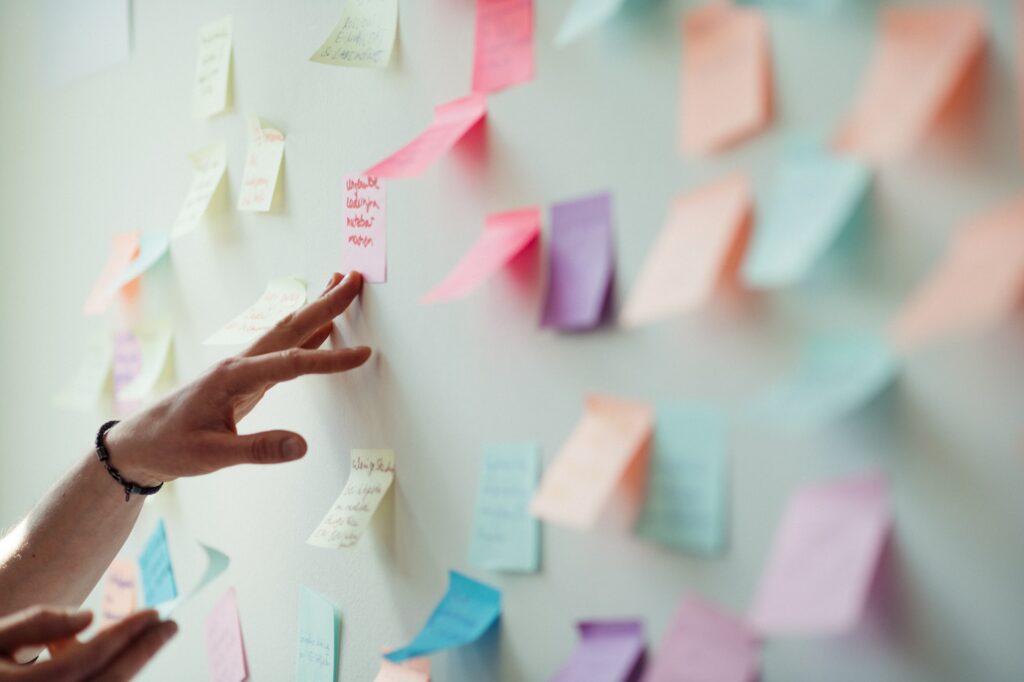
Subscribe to our mailing list and stay up to date!
What is MOSAIQ?
Imagine something: There is more space for people. The streets have more trees and plants. Everyone can get around better. That's how your Schwabing-West district could be in the future. How would you like your district to be? We want to talk to you about it!
The project is called MOSAIQ. MOSAIQ is a research∙project. MOSAIQ means: Mobility and urban climate in the future city∙part. The Technical University of Munich is leading the project.
What is MOSAIQ about?
MOSAIQ wants to make the streets in the city∙part more beautiful. People should feel comfortable there. There should be more space. For meetings and plants, for example. You can help decide what is tried out in the Stadt∙teil. The ideas come from you. Some ideas will be tried out on the streets for a certain period of time.
The aim of MOSAIQ is to make urban districts good places to live.
At the same time, the climate in the city should improve. And people should be able to move around the city easily.
What is happening in the district?