How can the findings from MCube have a long-term impact - beyond individual projects, regions and funding phases?
EPURA supports MCube as a strategic cross-sectional project with a focus on evaluation, process evaluation, upscaling, replication and application. The aim is to systematically evaluate and further develop project processes and results and make them usable for the metropolitan region and beyond.
Measuring impact. Secure knowledge. Enable implementation.
EPURA acts as an accompanying monitoring of the overall MCube strategy. The project improves internal processes, creates resilient exploitation and utilization strategies and promotes new implementation projects - locally, regionally and beyond existing funding structures.
Measure impact
We measure the impact of MCube projects using indicators. To this end, we develop project-specific evaluation plans, update the MCube indicator guide and carry out regular evaluation check-ins.
Enable learning
We continuously analyze project processes, identify barriers, risks and success factors and save lessons learned in a digital knowledge base for the cluster.
Thinking impact further
We are developing a practical tool that innovation projects can use to assess the impact of their solutions beyond the experimental stage - in terms of space, time and air quality.
Making knowledge transferable
Key findings are presented in compact replication guides. These support municipalities and other stakeholders in adopting and further developing successful MCube approaches.
Transfer into practice
We support the transfer of knowledge into entrepreneurship, implementation and education. EPURA connects MCube with relevant programs and initiatives to promote long-term social and economic impact.
Practical transfer in practice: MobyLauch
MobyLaunch is our low-threshold offer to turn research results into entrepreneurial action in a targeted manner. Developed together with the EIT Urban Mobility, MobyLaunch offers a hands-on guide on how to go from idea to start-up in 10 steps.
Lorem ipsum dolor sit amet, consetetur sadipscing elitr, sed diam nonumy eirmod tempor invidunt ut labore et dolore magna aliquyam erat, sed diam voluptua. At vero eos et accusam et justo duo dolores et ea rebum.
Our publications
Here you can find updates on the latest releases in the project
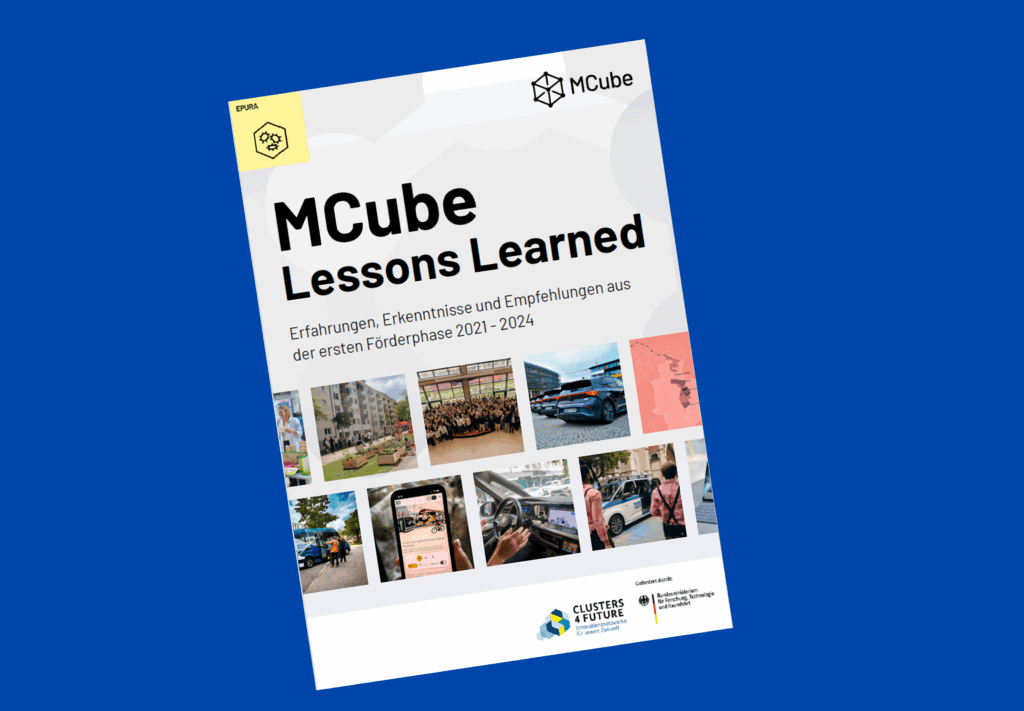
The lessons learned from the first MCube funding phase show which factors really drive projects forward - and where typical barriers arise.
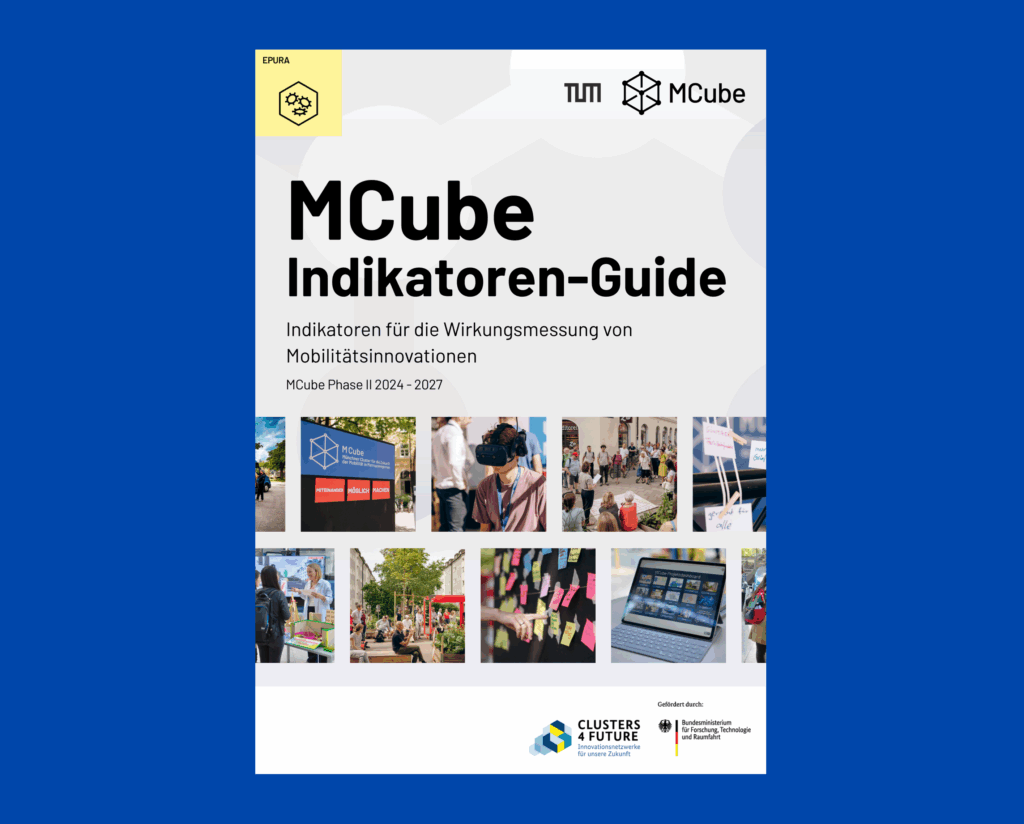
Creating transparency, proving impact, sharpening strategies - the new indicator guide supports precisely this.
There are no results matching your search
Experienced partners from science, administration, business and society work together in EPURA under the leadership of the Technical University of Munich.
At the Chair of Settlement Structure and Transport Planning at TUM, we research how cities or other forms of settlement and transport can be designed in such a way that all people can travel sustainably and reach their destinations with the shortest possible distances. We develop methods to find gaps in this accessibility and work together with society and practitioners to develop solutions for sustainable, livable and equitable urban development. In MCube Phase I, the Chair was involved in the real-world laboratory project aqt and other projects.
At the Chair of Traffic Engineering at TUM, we deal with the analysis, modeling and design of traffic systems. The focus is on the mobility of people and goods, the interaction of different modes of transport and the use of technical and digital solutions to control and optimize transport processes. We are particularly interested in future-proof, efficient and sustainable mobility concepts.
The Mobility Department (MOR) is the central point of contact for all strategic issues relating to mobility and transportation in Munich. Our goal is equal and safe coexistence on our roads and a better quality of life in Munich.
The Oberland section of the German Alpine Association (DAV) promotes mountain sports, nature experiences and safety in the Alps and other mountain regions. It organizes training courses, tours and events for members and interested parties and is committed to protecting nature and the alpine infrastructure. With specialist knowledge, commitment and practical experience, the Oberland section supports its members in organizing leisure, sport and mobility in alpine areas safely, responsibly and sustainably.
The EIT Urban Mobility Innovation Hub Central is a regional innovation and networking hub of the European initiative EIT Urban Mobility, which is based in Munich. It brings together stakeholders from municipalities, research, start-ups, companies and universities to develop, test and launch sustainable, digital and integrated mobility solutions for cities. Together with the entire EIT network, the hub supports start-ups in accessing funding, coaching and pilot projects, promotes cooperation and accelerates the implementation of innovative transport and mobility ideas in Europe.
As a practice-oriented research institute, the Fraunhofer IAO supports the development and implementation of innovative ideas for mobility, work and urban life. At the interface between science, business, municipalities and society, we play a central role in the testing, scaling and transfer of future-oriented technologies in urban areas.
Haselhorst Associates advises companies and public institutions on strategy, transformation and restructuring. A particular focus is on urban development: with smart city analyses, rankings and practical studies, the company supports cities and municipalities in planning sustainable infrastructure, efficient mobility and innovative urban development.
Netlight Consulting is an international digital and IT consultancy that supports companies in their digital transformation. In addition to technology and software solutions, Netlight also supports projects in the areas of mobility and urban infrastructure. Its approximately 2,000 consultants work in over ten countries and combine practical methods with strategic expertise to implement innovative solutions for business and society.
The TUM Think Tank combines research, politics, business and society in order to develop practical solutions for social challenges. Key topics are digital transformation, sustainability, urban development and mobility. Through studies, pilot projects and workshops, the Think Tank provides a sound basis for decision-making processes in administration, politics and business.
UnternehmerTUM is Europe's leading center for innovation and business creation. It supports people with ideas to develop sustainable start-ups and pioneering technologies.
MCube Consulting is the implementation and transfer arm of MCube, which transfers the knowledge gained in the cluster - especially through EPURA - in a structured way into practical application for municipalities, companies and other stakeholders.

Are you interested in working with MCube?
Then please get in touch with us.
What is MOSAIQ?
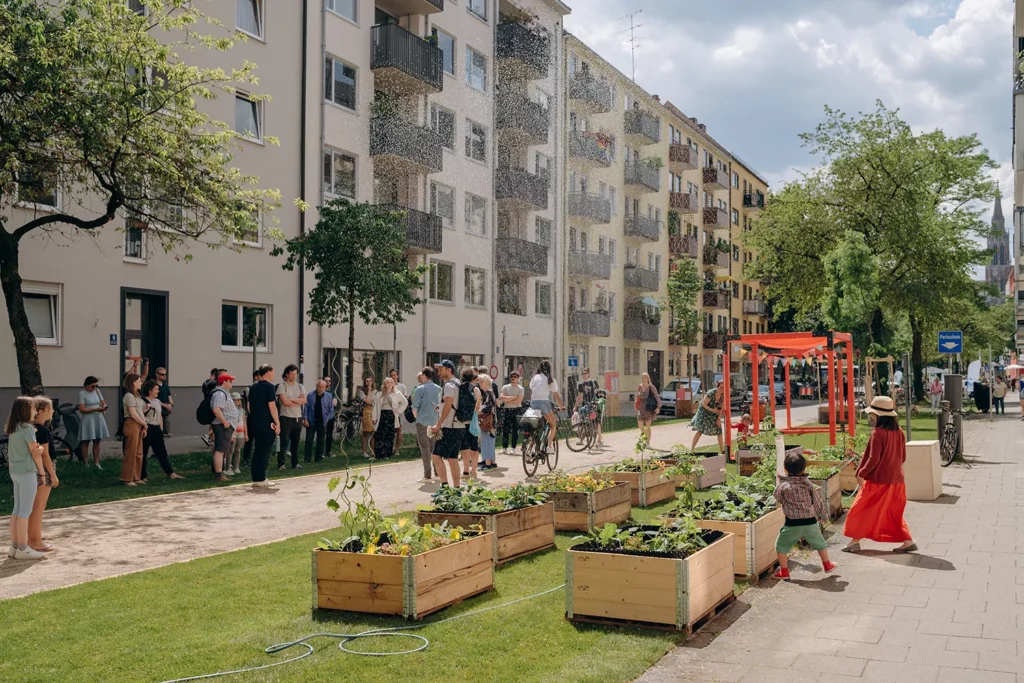
Imagine something: There is more space for people. The streets have more trees and plants. Everyone can get around better. That's how your Schwabing-West district could be in the future. How would you like your district to be? We want to talk to you about it!
The project is called MOSAIQ. MOSAIQ is a research∙project. MOSAIQ means: Mobility and urban climate in the future city∙part. The Technical University of Munich is leading the project.
What is MOSAIQ about?
MOSAIQ wants to make the streets in the city∙part more beautiful. People should feel comfortable there. There should be more space. For meetings and plants, for example. You can help decide what is tried out in the Stadt∙teil. The ideas come from you. Some ideas will be tried out on the streets for a certain period of time.
The aim of MOSAIQ is to make urban districts good places to live.
At the same time, the climate in the city should improve. And people should be able to move around the city easily.
What is happening in the district?