MCube Lessons Learned - experiences, findings and recommendations from Phase 1

What makes innovation projects really successful?

Innovation projects are complex. Different stakeholders, different interests, new ideas - and often unclear paths to the goal. But which factors actually contribute to success? And where are the typical stumbling blocks? The Lessons learned from the first MCube funding phase provide well-founded answers.

Driver & Barrier: Making success factors visible

As part of the MCube process evaluation, the factors that promoted the achievement of objectives in the projects (Driver) - and which ones inhibit them (Barrier) - have. Overall twelve learning history focus groups with project teams from science, business and administration formed the basis of the analysis. Together, key experiences were reflected upon, challenges openly discussed and concrete solutions developed.

The evaluation team bundled these findings and condensed them into clear, practical lessons learned.

The result: a sound knowledge base that can strengthen future MCube projects - and comparable transdisciplinary innovation projects - in a targeted manner.

Reflecting together - improving together

The lessons learned were developed in a transdisciplinary exchange format that consciously brings together different perspectives. This change of perspective is particularly crucial in complex innovation processes:

  • Structural hurdles are recognized early on

  • Success factors can be systematically strengthened

  • Project processes can be strategically developed further

The Learning History focus groups are part of the Transdisciplinary Process Evaluation (TPE), which was carried out in every MCube project. It creates a structured space for reflection - and makes implicit experiential knowledge explicitly usable.

Learning for the next funding phase - and beyond

With the lessons learned, MCube not only creates transparency about past processes, but also lays the foundation for the next funding phase. The results support the strategic further development of the cluster and promote the overarching transfer of experience and knowledge.

After all, real innovation is not only created through new ideas - but also through the ability to systematically learn from experience.

Click here to download: Lessons Learnd
Creating transparency, proving impact, sharpening strategies - the new indicator guide supports precisely this.

For the first time in this format, students made their way to three European cities. They went to Stockholm, Tallinn/Helsinki and Barcelona.

This time, mobility in the cities of Ljubljana, Genoa and Utrecht was examined.

How can mobility data and simulations make cities more liveable - and change visible and tangible?

What do Brussels, Lisbon, Milan and Paris have in common?

Where to put cars, bicycles and e-scooters - and how do we organize parking space fairly, efficiently and sustainably?

The Mobi-Score - The hidden costs of mobility at a glance

Resilient change towards sustainable mobility - lessons for a transformative urban mobility policy

Experimenting for the mobility transition - impetus for municipalities to dealing with real-world laboratories

Public spaces and social participation - The WHAT and HOW of comprehensive Participation for a local mobility transition

Easy language

What is MOSAIQ?
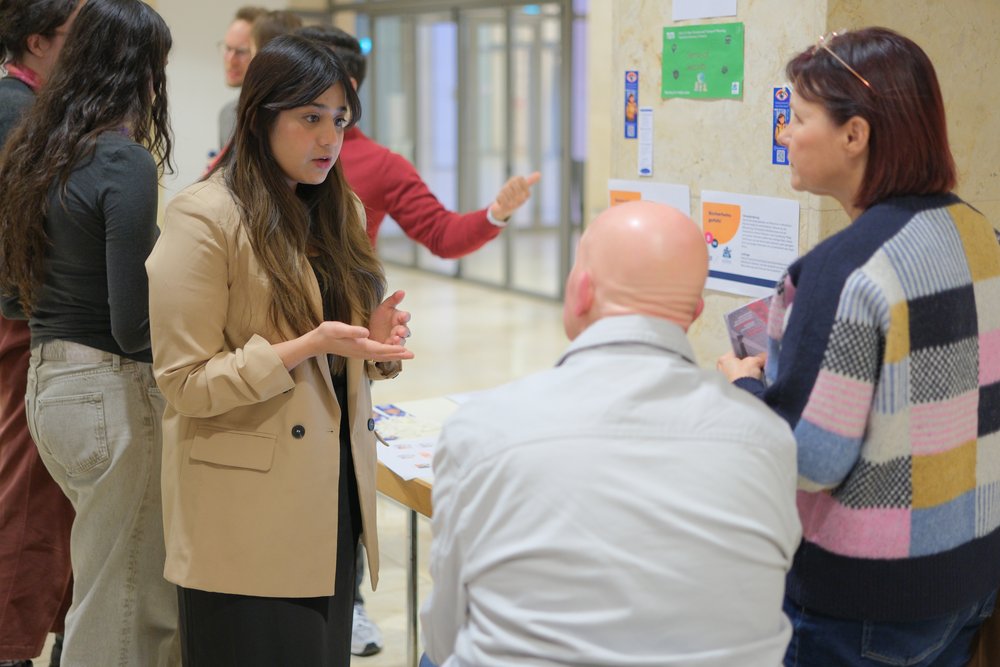
Imagine something: There is more space for people. The streets have more trees and plants. Everyone can get around better. That's how your Schwabing-West district could be in the future. How would you like your district to be? We want to talk to you about it!

The project is called MOSAIQ. MOSAIQ is a research∙project. MOSAIQ means: Mobility and urban climate in the future city∙part. The Technical University of Munich is leading the project.

What is MOSAIQ about?
MOSAIQ wants to make the streets in the city∙part more beautiful. People should feel comfortable there. There should be more space. For meetings and plants, for example. You can help decide what is tried out in the Stadt∙teil. The ideas come from you. Some ideas will be tried out on the streets for a certain period of time.
The aim of MOSAIQ is to make urban districts good places to live.
At the same time, the climate in the city should improve. And people should be able to move around the city easily. 

What is happening in the district?

  • In the year 2025:
    The people in the district can participate. They can express their ideas. There are discussions, surveys and meetings. Researchers are also starting their work.
  • In the year 2026:
    Some ideas are tried out.
    They are moved around the streets for a certain period of time.
  • In the year 2027:
    The results are evaluated.
    Consideration is given to how things can continue∙.